Free | Online | Self Paced
- Application closes on 15th May 2025
Key Highlights of The Role of Railways in Transportation
This program is designed for students and fresh graduates seeking an introduction to the railway and transportation sector; railway, metro, and infrastructure aspirants preparing for technical or managerial roles; and early-career professionals working in transportation, logistics, urban planning, or infrastructure development. It is also suitable for policymakers, consultants, and professionals from allied sectors who want to understand the strategic, organizational, and economic role of railways in building sustainable and integrated transportation systems.
- Comprehensive understanding of railways as the backbone of national and regional transportation systems
- Insights into the economic, strategic, and environmental impact of rail transport
- Clear overview of railway organizational structure, governance, and core departments
- Practical understanding of coordination with government bodies, regulators, and industry partners
- Exposure to multimodal transportation and digital integration in modern railways
- Introduction to performance measurement, risk management, and strategic implementation in rail systems
- Awareness of future trends, innovation, and sustainability challenges in the railway sector
- Students pursuing or completed 10+2, Diploma, or any Undergraduate program
- Fresh graduates and early-career professionals from engineering, management, logistics, or transportation-related backgrounds
- Railway, metro, and infrastructure job aspirants
- Basic understanding of transportation systems is helpful but not mandatory
- Open to learners from non-technical backgrounds with an interest in railways and mobility systems
After completing this program, participants will be able to:
- Understand the strategic role of railways in national transportation and economic development
- Explain the fundamentals of railway operations, organization, and governance
- Identify key railway departments and their functions within large transport systems
- Recognize the importance of coordination with government agencies, regulators, and industry partners
- Appreciate the role of railways in multimodal transport and logistics integration
- Understand performance measurement, safety, and risk management in railway systems
- Gain awareness of emerging trends, digital transformation, and sustainability in modern railways
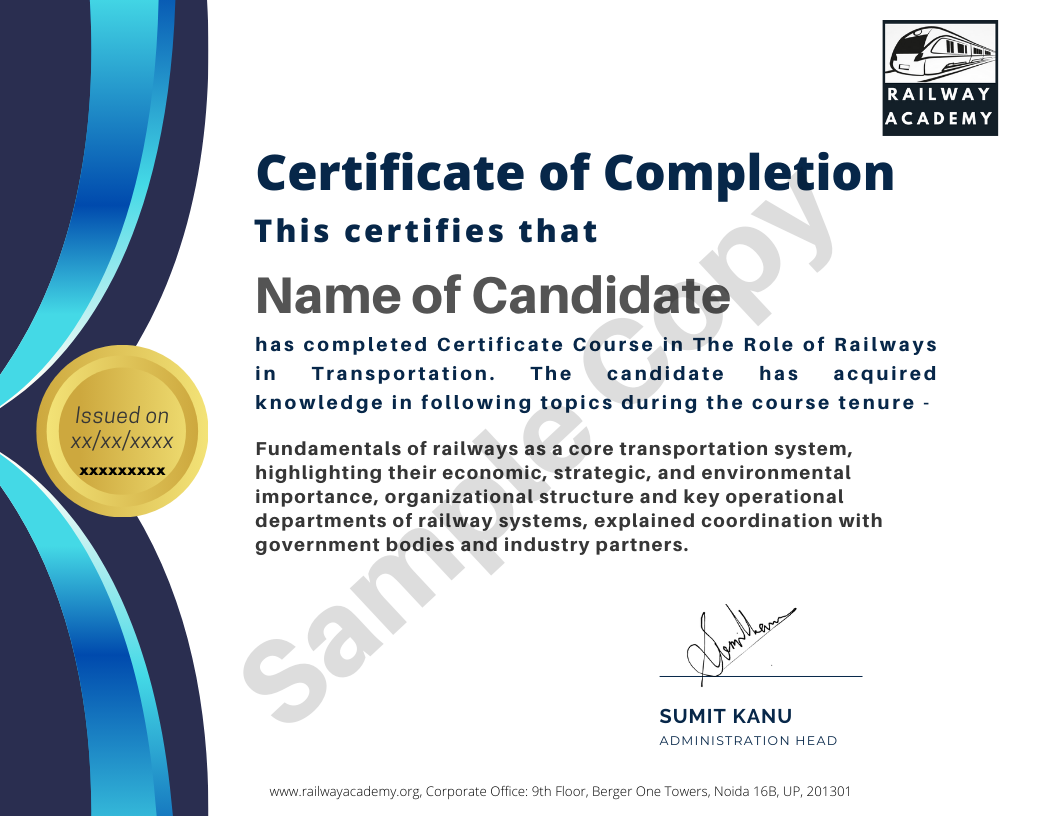
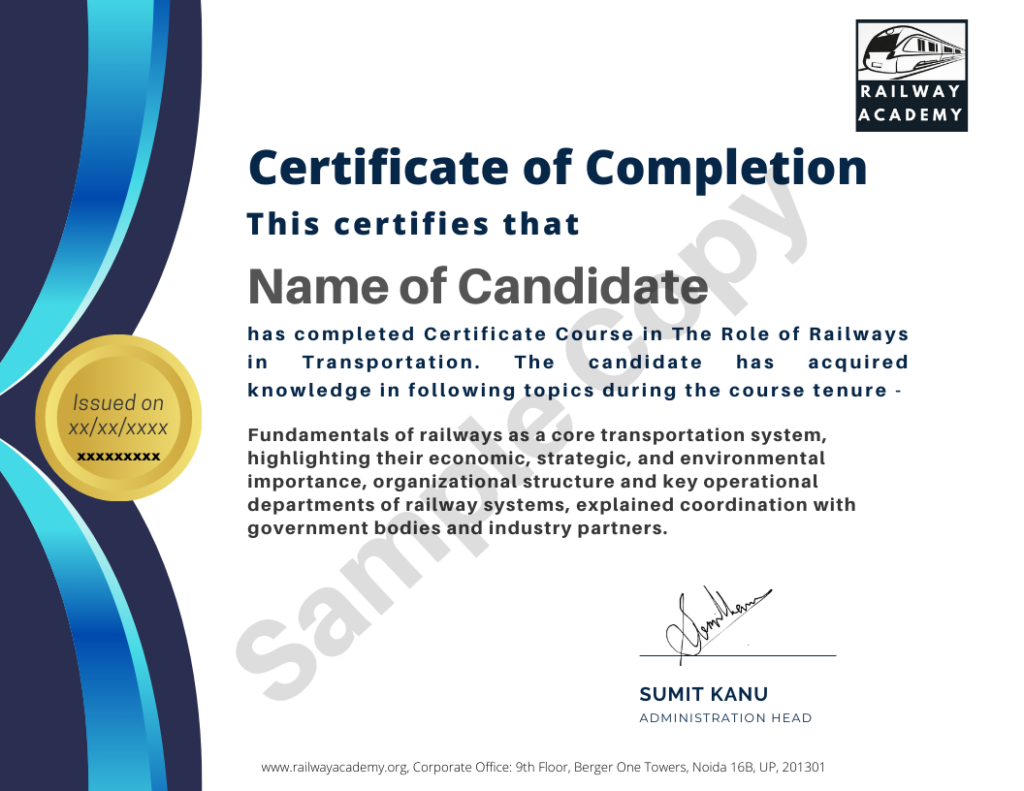
Get Certified by Railway Academy
Get a globally recognized certificate upon course completion.
Enrollment Process for Free Courses
Buy Course
Get access to the Course within the next 24 business hours of enrollment. The access is valid for 90 days.
Get Course access details in your Inbox
Our team will send you your login credentials to access the course hosted on our learning management system.
Complete Course & apply for certification and assessment
Once you complete the course, write an email to [email protected] to get assessment link.
This Course Includes
Course Duration
2 Hrs
Date of Start
Anytime
Class Timings
As per your convenience
Course Type
Free

Curriculum
Topics Covered
- Railways as the Backbone of Transportation
- Railways as critical national infrastructure
- Role in economic development, mass mobility, and sustainability
- Railways as a strategic national asset
- Efficiency of Rail Transport
- Freight and passenger transport efficiency
- Cost advantage over road transport for long-distance movement
- Volume, distance, and energy efficiency concepts
- Economic & Industrial Impact of Railways
- Industrial corridor development
- Farm-to-market connectivity
- Regional economic multiplier effects
- Strategic Mobility Functions
- National integration and regional connectivity
- Military logistics and strategic readiness
- Disaster response and emergency evacuation
- Environmental Benefits of Rail Transport
- Emission reduction
- Energy efficiency per ton-km
- Land-use efficiency compared to road transport
Learning Outcomes
After this session, participants will be able to:
- Explain why railways are considered the backbone of national transportation systems
- Describe the economic, strategic, and environmental advantages of rail transport
- Understand the role of railways in national security, disaster management, and sustainability
Topics Covered
- Hierarchical Structure of Railway Organizations
- Ministry-level governance
- Central boards and policy oversight
- Regional divisions and operational zones
- Role of local and field-level teams
- Functions of Railway Ministry & Central Boards
- Policy formulation and strategic planning
- Budget allocation and infrastructure investment
- Safety regulations and quality standards
- Regional & Divisional Management
- Geographic jurisdiction
- Asset and personnel management
- Performance metrics and KPIs
- Core Railway Departments
- Operations (train scheduling, traffic control)
- Engineering (track, bridges, rolling stock)
- Signaling & telecommunications (safety systems)
- Coordination Within Railway Operations
- Communication flows
- Planning, execution, and feedback mechanisms
- Role clarity across departments
Learning Outcomes
After this session, participants will be able to:
- Understand how large railway organizations are structured and managed
- Identify key departments and their operational responsibilities
- Explain how coordination enables safe and efficient railway operations
Topics Covered
- Coordination with Government & Regulatory Bodies
- Legislative frameworks affecting railways
- Safety oversight agencies
- Environmental compliance authorities
- Standardization & Regulatory Compliance
- National and international railway standards
- Technical harmonization for interoperability
- Safety protocols and performance benchmarks
- Industry & Technology Partnerships
- OEMs and service providers
- Technology and R&D partnerships
- Outsourcing and maintenance contracts
- Multimodal Transportation Integration
- Rail–road–port interfaces
- Containerized freight and logistics hubs
- Passenger multimodal journey planning
- Digital & Data Integration
- Real-time data sharing
- Mobile platforms for passengers
- Cloud-based transport management systems
Learning Outcomes
After this session, participants will be able to:
- Explain how railways coordinate with governments, regulators, and industries
- Understand the importance of standards and interoperability
- Recognize the role of railways within integrated multimodal transport systems
Topics Covered
- Strategic Implementation Framework
- Capability assessment
- Planning and execution stages
- Monitoring and evaluation
- Performance Measurement in Railways
- On-time performance
- Safety indicators
- Customer satisfaction metrics
- Risk & Financial Management
- Operational and safety risks
- Financial planning and budget allocation
- Infrastructure vs operations vs innovation spend
- Innovation & Digital Transformation Roadmap
- Digital signaling
- Autonomous operations
- System-wide integration
- Future Challenges & Opportunities
- Climate change and resilience
- Urbanization and capacity expansion
- Skills and technology adoption
Learning Outcomes
After this session, participants will be able to:
- Understand how railway strategies are implemented and measured
- Identify key success factors and risks in railway operations
- Appreciate future trends shaping modern and sustainable railways
Stay updated with expert articles on Career guidance, talent development, and evolving market trends.
Railway Careers & Industry Insights
Lorem Ipsum is simply dummy text of
Lorem Ipsum is simply dummy text of the printing and typesetting industry. Lorem Ipsum has been the industry’s standard dummy text ever since the 1500s
Lorem Ipsum is simply dummy text of
Lorem Ipsum is simply dummy text of the printing and typesetting industry. Lorem Ipsum has been the industry’s standard dummy text ever since the 1500s
Lorem Ipsum is simply dummy text of
Lorem Ipsum is simply dummy text of the printing and typesetting industry. Lorem Ipsum has been the industry’s standard dummy text ever since the 1500s
What Our Learners Have To Say
I have completed 50hrs online Railway Signalling Design course . Mentors of Railway Academy are very good and helpful. Through this online training course I improved my knowledge and skills in Signalling concepts, Interlocking principles,SIP & ESP preparation, Table of Control. Railway Academy is very helpful for me. Thanks Railway Academy.
Sanoj Kumar
MAINTENANCE ENGINEER (HITACHI RAIL STS)
Thank you so much Railway academy for gave the good and valuable time to us to Increased the knowledge and skills of railway signalling . You’ve made a big impact!
Priyanshu Jain
Priyanshu Jain Railway signalling , Electronic Interlocking, Site Engineer, Hitachi Rail STS
e mind”. During the first half of this year, I had the great opportunity to interact, collaborate and learn—functional Safety for Railways and Metro from Railway Academy. Thank you for all the support and encouragement.
DINESH KUMAR THANGAMARIAPPAN
MIRSE | Solutions Engineering Manager | Frauscher Sensor Technology
Thank You Railway Academy for organizing such a wonderful course. All the topics were nicely covered and explained by Sir Kirtivasan. I would highly recommend this course for Signaling professionals or anyone who wants to dive deep in signaling.
Rahul Pandey
AMIRSE MIET | Assistant Shift Supervisor at Alstom | IRSE
Thank You Railway Academy for organizing such a wonderful course. All the topics were nicely covered and explained by Sir Kirtivasan. I would highly recommend this course for Signalling professionals or anyone who wants to dive deep in signalling.
Andre McKenzie
Senior System Engineer -Train Control at Sound Transit | IRSE
It’s my pleasure to share that I’ve obtained another new certification: Table of Control (Indian Railways) from Railwayacademy! Thank you so much for the interactive and informative session…I really enjoyed and learnt a lots from it. This is quite refreshing .
Amritansh Singh
Engineer:- Railway Signalling (Hitachi Rail STS
Frequently asked questions
Got a question? Here are answers to the most common things learners ask before joining our programs.
What is the promise of Railway Academy's Micro Courses?
Micro or capsule courses are globally preferred by working professionals today because they are short, focused, and outcome-driven. They help you stay updated with industry trends, gain niche skills, and make faster career moves—all without the need for long-term commitments.
Railway Academy’s Micro Courses are designed to deliver industry-relevant, high-impact learning in a concise format, making it easier for busy professionals to upgrade their knowledge and remain competitive in the fast-evolving rail sector.
– Gain clarity on specialized topics
– Prepare for role transitions or certifications
– Build competencies required in today’s global railway sector
Upon successful completion, you will receive a globally recognised certificate from Railway Academy, adding weight to your profile in the rail industry.
Are these programs credible and trusted in the rail industry?
Yes. Railway Academy is a trusted name in the railway training domain. Our certifications are recognised across the industry, and thousands of professionals have benefited from our programs.
Who should consider enrolling in these courses?
These programs are ideal for:
– Professionals transitioning between functions (e.g., rolling stock to RAMS, telecom to signaling, O&M to design)
– Engineers preparing for roles in safety, system assurance, or international certifications like IRSE
– Fresh graduates looking to strengthen their industry knowledge
– Experienced professionals aiming to upskill and stay current
What is the eligibility to join these Micro Courses?
These are intermediate to advanced-level programs. Please refer to the course page for specific eligibility criteria.
What is the mode of delivery – Live or Self-paced?
We offer two formats:
– Self-paced Courses: Learn at your convenience with one-year access to recorded lectures, resources, and support.
– Live Online Courses: Delivered via Zoom, scheduled on evenings or weekends.
What is the time commitment required for these courses?
Self-paced: 3–4 hours per week is sufficient to stay on track.
Live Courses: Typically conducted over 2–4 sessions (depending on course), each session lasting 2–3 hours.
What kind of certification will I receive?
You will receive a Certificate of Completion from Railway Academy, which is highly regarded by recruiters and employers in the railway and transport sector.
What is the assessment process?
Courses include an online, proctored assessment (typically 60–90 minutes, multiple-choice format). A minimum score of 60% is required to pass.
– You get two free attempts.
– Further attempts cost USD 50 per attempt.
What support is provided during and after the course?
24×7 student support via email and WhatsApp
Course coordinators to keep you on track
One-year access to course materials and updates
Help with queries even after course completion
Will I get job support after completing the course?
We offer exclusive job alerts, industry updates, and networking support through alumni groups and social media channels.
When will I get access to the course after enrollment?
LMS access is provided within 24 business hours post-enrollment, along with recorded classes, PDFs, assignments, and more.
Will I still have access to course content after completing the course?
Yes, all learners get one-year access to course content and updates—even after completing the program.
What if I have questions after completing the course?
Support is available for up to one year after enrollment via email or WhatsApp.
Is there a refund or cancellation policy?
All programs are non-refundable and non-cancellable. Please read the program details carefully before enrolling.
Are there any EMI or payment flexibility options?
You can use your credit card to convert the fee into EMIs at the time of checkout as per your provider’s offers.
Can I refer a friend or colleague?
Yes. Please email [email protected] to learn about referral benefits.
Why choose online training over offline classroom training?
Online training offers global access, one-year content availability, flexible learning, expert instructors, and round-the-clock support.
Similar Railway courses for you
Explore related programs from Railway Academy designed to help you expand your expertise and advance your career in the global railway industry.
Free Course – Overview of EMC Fundamentals- Railways
Free Course – The Role of Railways in Transportation
Free Course – Railway Safety and Regulations
Free Course – Overview of High Speed Rail and Signaling Systems
Free Course – Introduction to Telecommunication Systems of Indian Railway & Metro Railway