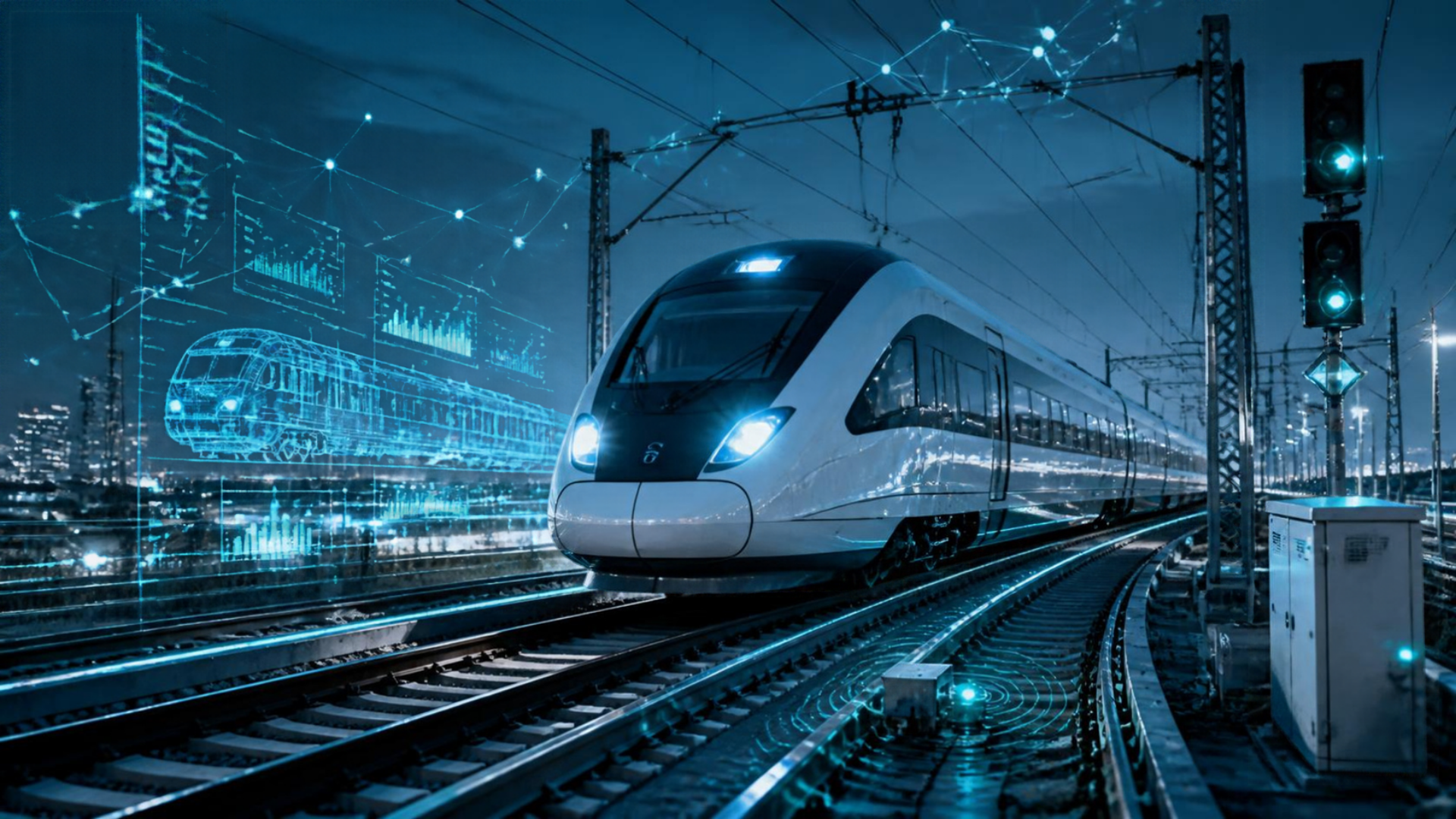
Artificial Intelligence (AI) is rapidly changing the way railway systems are designed, operated, maintained, and managed. What was once associated mainly with futuristic automation is now being applied to practical railway challenges—from predictive maintenance and intelligent traffic management to computer vision, energy optimization, and autonomous train operations.
As railway networks become more complex and passenger expectations increase, AI is emerging as an important technology for building safer, more efficient, and data-driven transportation systems.
What Is Artificial Intelligence in Railways?
Artificial Intelligence in railways involves the application of technologies such as machine learning, computer vision, data analytics, natural language processing, and intelligent automation to railway systems.
Unlike conventional systems that primarily follow predefined rules, AI-based solutions can identify patterns in large volumes of data and support faster, more informed decisions. This makes AI particularly valuable in environments where railway assets, trains, passengers, and infrastructure generate continuous streams of operational data.
Key Applications of AI in the Railway Industry
1. Predictive Maintenance
One of the most promising applications of AI is predictive maintenance. Traditional maintenance can be time-based or reactive, while AI enables condition-based approaches.
Data collected from sensors and monitoring systems can be analyzed to identify abnormal behavior in:
- Tracks and track geometry
- Rolling stock
- Bearings and wheels
- Braking systems
- Signalling equipment
- OHE and traction systems
By identifying deterioration before a major failure occurs, AI can help railway operators improve asset availability, reduce unplanned downtime, and optimize maintenance activities.
2. Intelligent Signalling and Train Operations
Modern railway systems such as ETCS, CBTC, ATP, ATO, and Kavach increasingly depend on sophisticated digital technologies.
AI can complement these systems through traffic prediction, anomaly detection, timetable optimization, and operational decision support. By analyzing train movements and network conditions, intelligent systems can help optimize headways, reduce congestion, and improve network capacity.
However, AI does not simply replace safety-critical railway signalling logic. In safety-related applications, its outputs must operate within appropriate engineering, verification, validation, and regulatory frameworks.
3. Autonomous and Driverless Trains
AI is also contributing to the development of increasingly automated railway operations, particularly in metro systems.
For GoA4 Unattended Train Operation (UTO), automated systems continuously monitor train movement, platform conditions, obstacles, and operational parameters. Computer vision and sensor technologies can further support platform monitoring, obstacle detection, and depot automation.
The objective is not simply to remove the driver, but to create an integrated operational environment capable of responding reliably to changing conditions.
4. Railway Safety and Infrastructure Monitoring
AI-powered computer vision and analytics can process large quantities of visual and sensor data to identify potential hazards.
Applications include:
- Track intrusion detection
- Level-crossing monitoring
- Infrastructure defect identification
- Rolling stock inspection
- Platform surveillance
- Abnormal behavior detection
These technologies can support railway personnel by identifying events that may otherwise be difficult to detect through conventional monitoring.
5. Energy Optimization
Energy efficiency is another important area where AI can contribute.
AI-based models can analyze train operating patterns, gradients, timetable constraints, traction demand, regenerative braking, and HVAC loads to identify opportunities for reducing energy consumption.
Intelligent driving strategies can potentially balance punctuality, passenger comfort, operational constraints, and energy efficiency rather than optimizing any one factor in isolation.
AI and the Digital Railway
The future of railway digitalization is likely to involve the convergence of AI, IoT, Big Data, cloud computing, digital twins, advanced communications, and cybersecurity.
Technologies such as FRMCS, advanced signalling, connected rolling stock, and digital asset management will generate increasingly large volumes of data. AI can transform this data into operational insights and predictive intelligence.
However, greater connectivity also introduces new cybersecurity, data governance, explainability, and safety-assurance challenges. For safety-critical railway applications, AI must therefore be treated as part of a broader systems-engineering framework rather than as an isolated technology.
What Does AI Mean for Railway Professionals?
AI is creating a growing need for professionals who understand both railway engineering and digital technologies.
Future opportunities will span signalling, rolling stock, railway operations, telecommunications, cybersecurity, data science, automation, and asset management. Engineers who can connect railway-domain knowledge with AI and data-driven methodologies will be increasingly valuable as railway organizations modernize their systems.
Conclusion
Artificial Intelligence is moving from experimentation toward practical application across the railway industry. Its greatest potential lies not in replacing conventional railway engineering, but in augmenting human expertise with faster analysis, predictive capabilities, and intelligent decision support.
The railway of the future will increasingly be connected, automated, data-driven, and intelligent. The challenge for the industry will be ensuring that this intelligence is implemented with the same discipline, safety assurance, and engineering rigor that have always defined modern railway systems.