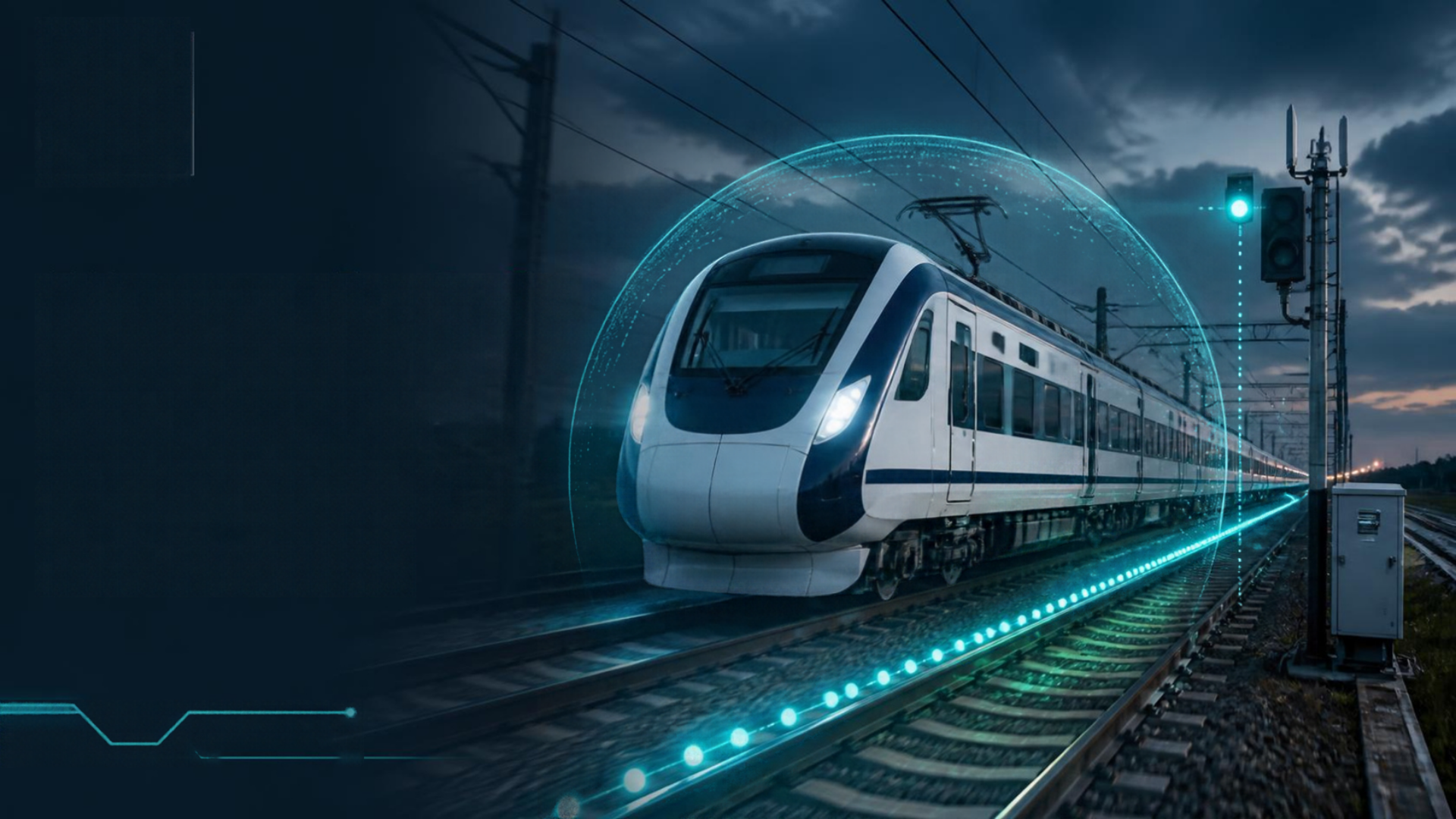
A railway can have modern signalling, powerful locomotives and highly trained crews—and still face a critical safety risk if a train continues moving when it should stop.
That is where Automatic Train Protection (ATP) becomes important.
India’s Kavach is being developed as an indigenous ATP system designed to support safer train operation by monitoring train movement, signalling information and speed, and intervening when necessary. With the evolution of Kavach Version 4.0, the focus is moving beyond a basic protection system toward a more integrated railway safety architecture.
From Train Protection to Intelligent Supervision
At its core, Kavach is designed to address some of the most important operational risks: Signal Passing At Danger (SPAD), excessive speed and unsafe train movements.
The underlying principle is straightforward. The system continuously determines where the train is, what movement authority or restrictions apply, and whether the train is operating within safe limits. If the required action is not taken by the locomotive crew, the system can initiate braking.
This is not intended to replace the locomotive pilot. Indian Railways' training material explicitly describes Kavach as an additional aid to the Loco Pilot, with existing operating and safety rules continuing to apply. (Indian Railways)
The engineering challenge, therefore, is not simply “Can the system apply the brakes?”
It is:
Can the system reliably determine when braking is required—and do so safely under real railway operating conditions?
That is a much more demanding systems-engineering problem.
What Makes Kavach 4.0 Significant?
The RDSO specification for Kavach Version 4.0 describes an architecture incorporating trackside equipment, onboard equipment, network monitoring and temporary speed restriction management. It also specifies compatibility with existing Kavach installations and operation across both electrified and non-electrified territories.
The onboard architecture includes a vital computer, RFID readers, radio communication equipment, Driver Machine Interface and interfaces with the braking system, among other elements. The specification also provides for redundancy and extensive event/data recording.
These details matter because train protection is fundamentally a system-of-systems problem.
A protection decision depends on multiple elements working together:
Train location → speed measurement → trackside information → signalling information → communication → onboard processing → braking interface
A weakness or failure in any critical interface can affect the overall safety function.
That is why Kavach development cannot be viewed simply as installing equipment on locomotives and tracks.
The Hardest Part: Proving Safety
One of the most interesting aspects of modern railway protection is that having a safety function is not the same as proving that the function is safe.
Consider a simple scenario.
A train approaches a restrictive signal. The system must know the train's position, understand the relevant movement authority, calculate the permitted speed profile and determine whether intervention is necessary.
Now introduce uncertainty:
- What if location information is imperfect?
- What happens if communication is interrupted?
- What happens when equipment becomes degraded?
- What happens when redundant components disagree?
- How is incorrect or stale information handled?
- What happens during maintenance or degraded operation?
These are classic RAMS and safety-assurance questions.
The objective is not merely to demonstrate that the system works during normal operation. Engineers must also analyse failures, hazards, interfaces, degraded modes and the behaviour of the system when assumptions are violated.
This is where concepts such as hazard analysis, risk assessment, reliability, availability, fault detection, redundancy and safety integrity become central.
Version 4.0 Is Also an Integration Challenge
Another important dimension is interoperability.
Railway networks contain legacy signalling, different rolling-stock configurations, diverse infrastructure and multiple operational environments. Kavach therefore has to function as part of the existing railway rather than as an isolated technology.
The Version 4.0 specification explicitly addresses compatibility and interoperability with existing Kavach systems.
That makes interface engineering particularly important.
The question is no longer only:
“Does Kavach work?”
It becomes:
“Does Kavach work correctly with the signalling, rolling stock, communications, operations and infrastructure around it?”
That distinction is fundamental to modern railway systems engineering.
The Bigger Picture for Indian Railways
Indian Railways' own documentation identifies Kavach development as an ongoing R&D activity, with Version 4.0 issued in July 2024 and deployment underway on multiple routes.
The significance of this development extends beyond one train protection product.
As railway networks become faster, more connected and increasingly dependent on software and digital communication, safety assurance becomes an engineering discipline in its own right.
Future railway professionals will need to understand not only signalling principles, but also how safety requirements flow from hazards into architecture, design, verification, validation and operational controls.
What Engineers Should Learn From Kavach 4.0
Kavach offers an excellent real-world illustration of a broader principle:
Railway safety is not created by one component. It is engineered across the entire system.
Understanding ATP therefore requires more than knowing how a protection system operates. Engineers need to understand how hazards are identified, how risks are evaluated, how safety requirements are allocated, how failures are controlled and how evidence is built to demonstrate that a railway system is acceptably safe.
For professionals looking to develop these capabilities, Zenith Railway Academy's Advanced KAVACH program provides a relevant learning opportunity, particularly for engineers working with railway signalling, CBTC, safety assurance and complex railway systems.
Because the next generation of railway safety will not be defined only by smarter technology—but by our ability to prove that the technology is safe.