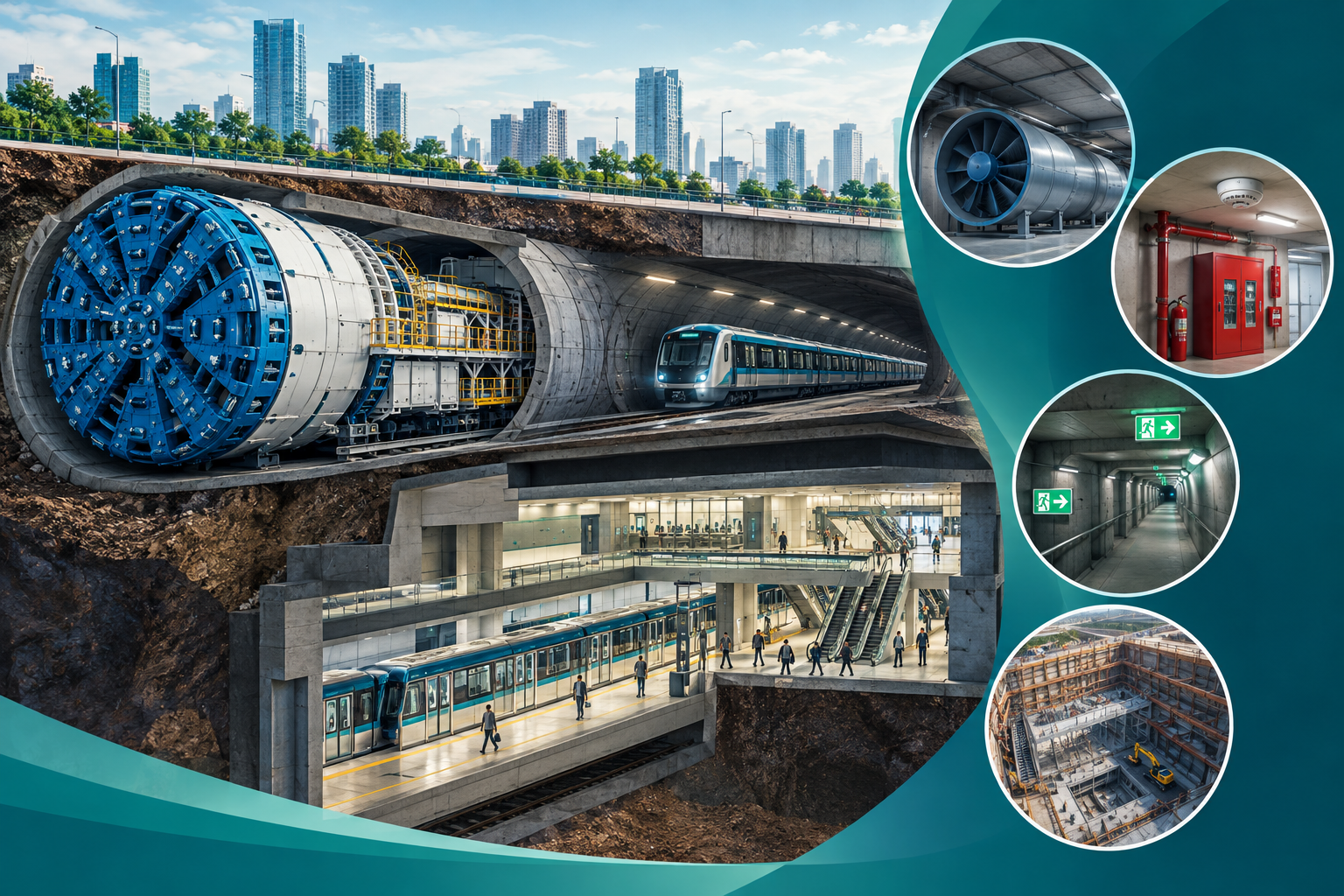
Every day, millions of passengers travel through underground metro systems, moving between stations in minutes. Yet beneath the familiar journey lies an extraordinary feat of engineering. From excavating tunnels beneath crowded cities to designing sophisticated ventilation and emergency evacuation systems, underground railways demand precision, innovation, and extensive safety planning.
Unlike surface railways, underground systems operate within confined spaces where geology, groundwater, structural stability, fire safety, and passenger movement must be carefully managed. Much of this engineering remains invisible to passengers, but it is essential to keeping trains running safely and reliably.
1. Tunnel Boring Machines: Digging Beneath Cities
One of the most remarkable technologies in underground railway construction is the Tunnel Boring Machine (TBM). These enormous machines excavate tunnels while helping control ground movement and maintain stability around the excavation.
However, tunnelling is far more complex than simply drilling through soil and rock. Engineers must investigate ground conditions, identify groundwater pressures, assess nearby foundations, and select an appropriate excavation method.
Different ground conditions require different TBM configurations. Earth Pressure Balance (EPB) machines are commonly used in soft ground, while slurry TBMs can be suitable for water-bearing and unstable ground conditions.
As excavation progresses, precast concrete segments are assembled to form a permanent tunnel lining. The annular gap behind the lining is typically filled with grout to provide support and limit ground settlement.
In densely populated cities, even small ground movements can affect buildings, roads, and underground utilities. Continuous monitoring and careful control of excavation parameters are therefore critical.
2. Ventilation: Keeping Underground Spaces Safe
Ventilation in underground railways serves a much broader purpose than supplying fresh air. It helps manage heat generated by trains, braking systems, electrical equipment, lighting, and passengers.
Engineers design ventilation systems to maintain acceptable environmental conditions across stations, tunnels, and technical rooms. These systems may include supply and exhaust fans, air ducts, shafts, dampers, and control equipment.
During normal operations, ventilation supports air circulation and thermal management. In an emergency, specially designed smoke-control and tunnel ventilation strategies can help manage smoke movement and protect evacuation routes.
The challenge is that airflow behaves differently depending on tunnel geometry, train movement, temperature differences, and the location of an incident. Ventilation strategies must therefore be coordinated with fire engineering and emergency response procedures.
3. Fire and Life Safety Engineering
Fire safety is one of the most demanding aspects of underground railway design. Confined spaces, limited access points, and potentially long evacuation routes make smoke management and passenger protection especially important.
Underground stations incorporate multiple layers of protection, which may include fire detection and alarm systems, emergency lighting, fire-resistant construction, firefighting equipment, and smoke-control systems.
Designers also consider the separation of critical equipment, protection of escape routes, and the ability of emergency services to access affected areas.
A key principle is that fire safety cannot depend on a single system working perfectly. Detection, communication, smoke control, evacuation provisions, and operational procedures must work together.
These arrangements are developed through applicable fire and life safety standards, engineering analysis, and scenario-based assessments.
4. Emergency Evacuation: Planning for the Unexpected
If a train becomes immobilised inside a tunnel, evacuating passengers safely can be a complex operation. Engineers must account for tunnel length, walkway availability, track arrangements, lighting, communication systems, and access to safe areas.
Evacuation design considers how quickly passengers can reach a place of safety, whether they can move away from smoke and other hazards, and how emergency responders can assist.
Depending on the system, provisions may include emergency walkways, cross-passages between twin tunnels, protected stairways, designated exits, and clear directional signage.
Designers also assess passenger numbers, mobility limitations, and the possibility of congestion at narrow passageways or exits.
Emergency planning extends beyond physical infrastructure. Staff training, communication protocols, control-centre procedures, and regular exercises are equally important to an effective response.
5. Underground Station Construction: Building in Confined Spaces
Constructing an underground station in a busy city presents a different set of challenges from building a tunnel. Stations require large excavations to accommodate platforms, concourses, passenger circulation areas, escalators, lifts, and technical rooms.
Two common approaches are cut-and-cover construction and mined or underground excavation methods. Cut-and-cover generally involves excavating from the surface and constructing the station structure before reinstating the surface. It can be effective where space and ground conditions permit, but may cause substantial disruption to roads, utilities, and surrounding activities.
Deeper stations may require specialised excavation techniques, retaining structures, groundwater control, and extensive structural support.
Engineers must also coordinate architecture, structural design, electrical systems, plumbing, fire protection, signalling, and passenger information systems within limited space.
The result is a highly integrated facility in which every component must fit, function, and remain accessible for maintenance.
The Engineering Behind Every Journey
An underground metro journey may last only a few minutes, but the engineering behind it represents years of investigation, design, construction, testing, and safety planning.
Tunnel boring machines create the passage. Structural systems maintain stability. Ventilation manages heat and smoke. Fire protection and evacuation provisions help safeguard passengers. Carefully coordinated station infrastructure brings everything together.
The real achievement of underground railway engineering is not simply building beneath a city. It is creating a safe, reliable, and efficient transport system within one of the most demanding environments in civil engineering.
The next time you travel through a metro tunnel, remember that the infrastructure you cannot see is just as important as the train you board.