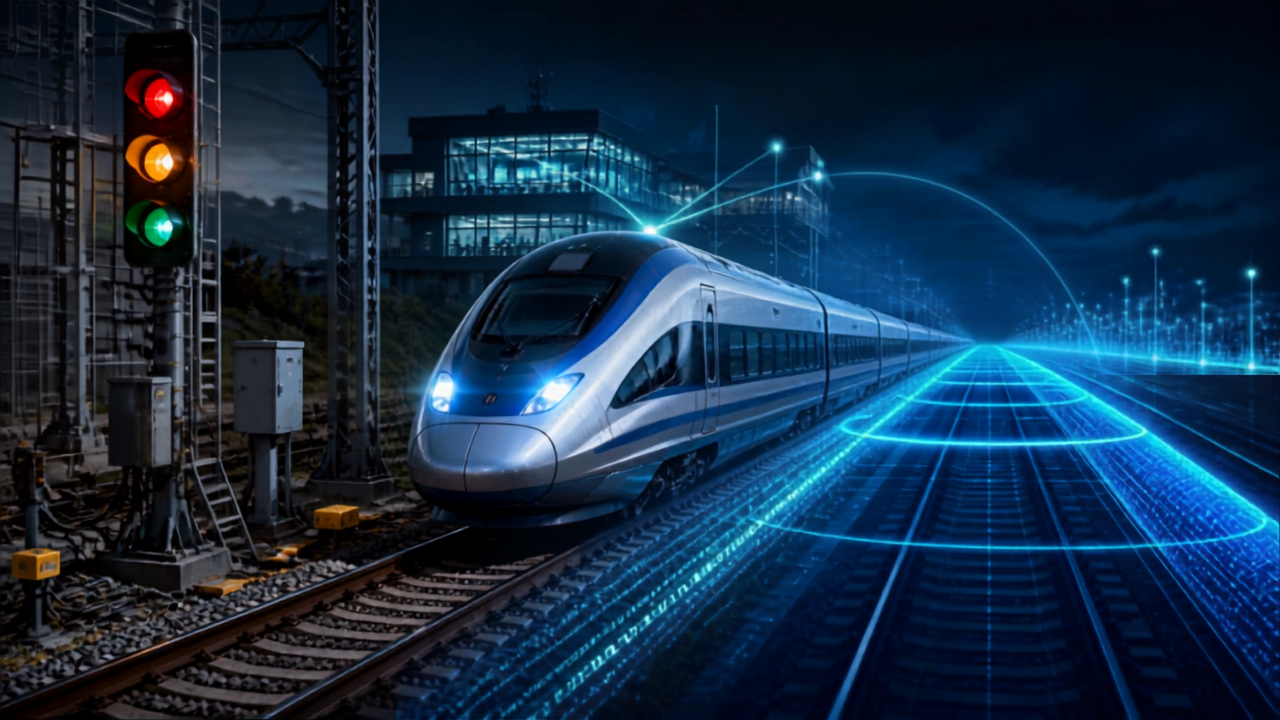
“Same system. 3 levels. Completely different engineering mindset.”
The railway industry is undergoing a silent revolution.
What once relied on trackside signals, relays, and fragmented safety systems is now transforming into a fully digital, data-driven ecosystem. At the heart of this transformation lies the European Train Control System (ETCS) — a global standard that is redefining how trains operate, communicate, and ensure safety.
But here’s what most engineers don’t realize:
- Understanding ETCS is not enough.
- Understanding the difference between its levels is what sets top engineers apart.
The Big Picture: One System, Three Philosophies
At first glance, ETCS Level 1, Level 2, and Level 3 may seem like incremental upgrades.
In reality, they represent three completely different ways of thinking about railway control systems:
- Level 1 → Enhancement of existing systems
- Level 2 → Transition to continuous communication
- Level 3 → Reinvention of train detection and capacity
ETCS Level 1: The Digital Overlay
Think of Level 1 as the starting point of digital transformation.
Key Concept:
- Uses balises (track-mounted transponders) to transmit information to the train
- Works as an overlay on existing signaling systems
Engineering Insight:
- Infrastructure-heavy
- Limited real-time capability
- Retains traditional trackside signals
Where It’s Used:
- Legacy railway upgrades
- Mixed traffic routes
- Cost-sensitive modernization projects
What top engineers know:
Level 1 is not about innovation — it’s about integration. It allows railways to step into ETCS without completely replacing their existing infrastructure.
ETCS Level 2: The Connected Railway
Level 2 is where the real shift begins.
Key Concept:
- Continuous communication via GSM-R (Global System for Mobile Communications – Railway)
- Movement Authority sent directly from Radio Block Centre (RBC) to the train
Engineering Insight:
- Eliminates dependency on lineside signals
- Requires robust telecom and control systems
- Enables real-time supervision
Where It’s Used:
- High-speed rail networks
- Dedicated freight corridors
- Modern metro and intercity systems
What top engineers know:
Level 2 is not just signaling — it’s systems engineering. It demands integration across telecom, software, and control systems.
ETCS Level 3: The Future of Railways
Level 3 represents a paradigm shift.
Key Concept:
- Moving block system (no fixed blocks)
- Train integrity is monitored onboard
- Continuous communication with control center
Engineering Insight:
- Eliminates trackside train detection (track circuits/axle counters)
- Maximizes line capacity
- Requires extremely high system reliability
Where It’s Headed:
- Next-generation high-capacity corridors
- Fully automated railways
- Future-ready metro and freight systems
What top engineers know:
Level 3 is not an upgrade — it’s a reinvention of railway operations.
Simple Comparison: What Makes Them Different
Feature
Level 1
Level 2
Level 3
Communication
Intermittent (Balises)
Continuous (GSM-R)
Continuous (Advanced Radio)
Trackside Signals
Required
Mostly removed
Fully eliminated
Train Detection
Track circuits
Track circuits / axle counters
Onboard (Train integrity)
Capacity
Moderate
High
Very High
Complexity
Low
Medium
Very High
Engineering Focus
Integration
System coordination
Full digital transformation
Real-World Applications
High-Speed Rail
Countries across Europe and Asia rely heavily on Level 2 for safe, high-speed operations.
Metro Systems
Modern CBTC-like operations align closely with Level 2 and emerging Level 3 concepts, enabling automation and high frequency.
Freight Corridors
Heavy-haul and long-distance freight networks benefit from Level 2 today, with Level 3 promising massive capacity gains in the future.
What Truly Differentiates Top Railway Engineers
It’s not just about knowing ETCS levels.
It’s about understanding:
- When to use which level
- How systems interact (signaling + telecom + rolling stock)
- What trade-offs exist between cost, capacity, and complexity
- How future-ready a system needs to be
The best engineers think beyond components — they think in systems, scalability, and strategy.
Why This Knowledge Matters for Your Career
The global railway industry is rapidly moving toward ETCS and digital signaling.
Engineers who understand:
- System architecture
- Interoperability
- Real-world implementation challenges
…are the ones leading projects — not just executing them.
ETCS Levels are not just technical classifications.
They represent the evolution of railway thinking:
- From hardware-driven systems
- To communication-driven systems
- To intelligence-driven systems
And those who understand this evolution… are the ones shaping the future of railways.
Want to go deeper?
Master ETCS Level 1, 2 & 3 with real-world engineering insights, case studies, and practical applications through our Advanced ETCS Certification Program at Zenith Railway Academy.
Because in today’s railway industry—
Knowing the basics is common. Thinking like a systems engineer is rare.