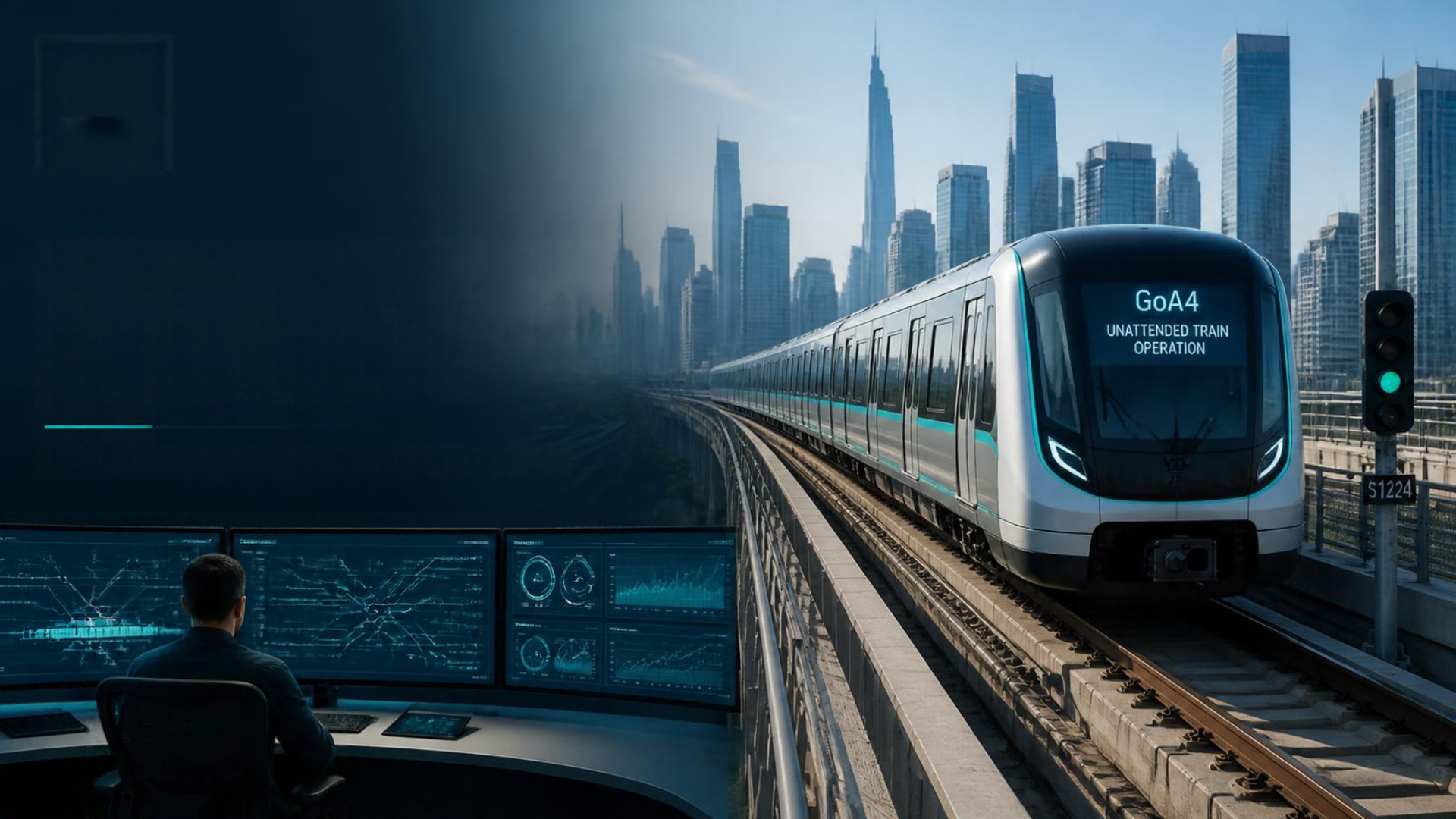
Urban rail transportation is entering a new era in which trains can operate without a driver in the cab. Across the world, metro systems are adopting advanced signalling, real-time monitoring, and intelligent control technologies to deliver safer, more frequent, and more efficient journeys. At the centre of this transformation is GoA4 (Grade of Automation 4), the highest level of railway operational automation.
As cities face growing passenger demand, limited infrastructure capacity, and pressure to improve service reliability, fully automated metro railways are becoming an increasingly important part of modern urban mobility.
Understanding GoA4: The Highest Level of Railway Automation
Railway automation is classified into four Grades of Automation (GoA), ranging from GoA1, which involves manual train operation, to GoA4, where train movements are fully automated without an onboard operating staff member responsible for driving.
Under GoA4, also known as Unattended Train Operation (UTO), the system can manage train starting, stopping, speed regulation, door operations, and responses to routine operational conditions through integrated signalling and control technologies. These functions are supported by Automatic Train Operation (ATO), Automatic Train Protection (ATP), and Automatic Train Supervision (ATS), working together within the wider railway control architecture.
However, unattended operation does not mean the absence of human oversight. Operations control centres, maintenance teams, and emergency response personnel remain essential to managing disruptions, equipment failures, and passenger safety.
How Automated Metro Systems Improve Performance
1. Higher Capacity and Operational Efficiency
One of the most significant advantages of automated metro systems is their ability to support more frequent and consistent train services.
Advanced signalling technologies, particularly Communications-Based Train Control (CBTC), enable continuous communication between trains and wayside equipment. Depending on the system design, moving-block or other advanced train-separation principles can help reduce headways while maintaining required safety margins.
With automated speed control, precise stopping, and optimised acceleration and braking, metro operators can improve timetable adherence and make better use of existing infrastructure without necessarily constructing additional tracks.
2. Enhanced Safety and Reliability
Fully automated operation reduces dependence on human driving actions and supports consistent execution of operational rules. Automatic Train Protection supervises train speed and enforces movement limits, intervening when necessary to prevent unsafe movements.
Automation can also reduce variability in driving behaviour, improve stopping accuracy at platforms, and enable continuous monitoring of train and infrastructure conditions.
Nevertheless, automation does not eliminate risk. System reliability depends on robust engineering, redundant equipment, cybersecurity, fail-safe design, emergency procedures, and rigorous safety assurance. Human supervision remains crucial, particularly during abnormal situations.
3. Lower Operating Costs and Better Energy Management
Automated metro systems can improve operational economics by optimising train movements, reducing unnecessary acceleration and braking, and matching service frequency to passenger demand.
They may also reduce the need for onboard driving staff and improve fleet utilisation. However, these savings must be balanced against investment in advanced signalling, communications, platform safety systems, control centres, software maintenance, and specialist technical personnel.
Therefore, the financial benefits of automation depend on network size, operating patterns, existing infrastructure, and the lifecycle cost of the technology.
Passenger Acceptance: Trust Is as Important as Technology
For passengers, the real measure of automation is not simply whether a train operates without a driver. It is whether the journey feels safe, reliable, accessible, and comfortable.
Automated metros can offer predictable stopping, consistent service intervals, and improved service recovery. Yet some passengers may initially feel uncomfortable travelling without a visible driver, particularly during emergencies or service disruptions.
Clear passenger information, accessible emergency communication systems, trained response teams, and transparent safety procedures are essential to building public confidence. Successful automation must combine technological capability with a positive passenger experience.
What Does Automation Mean for Railway Jobs?
The transition towards driverless metro operations is reshaping railway careers rather than simply eliminating the need for people.
As routine driving functions become automated, demand can grow for professionals in signalling and train control, systems integration, cybersecurity, software engineering, reliability engineering, predictive maintenance, and safety assurance.
Operations control centre personnel, rolling stock specialists, and emergency response teams also remain important. Existing railway professionals may need to develop new competencies in digital systems, automated operations, data analytics, and fault diagnosis.
For aspiring railway engineers, this shift highlights the importance of understanding both traditional railway principles and emerging automation technologies.
The Future of Fully Automated Metro Railways
From advanced signalling to intelligent train supervision, GoA4 is redefining how urban rail networks are designed and operated. Its greatest potential lies in combining operational efficiency with robust safety engineering and passenger-focused service delivery.
As cities continue to expand their metro networks, fully automated operations are likely to play an increasingly significant role in urban transportation. The future will not be defined by algorithms replacing every human function, but by intelligent systems and skilled railway professionals working together to build safer, more reliable, and more efficient railways.