Higher than the Eiffel Tower, engineered to withstand extreme winds and earthquakes, and designed to last 120 years. Discover the remarkable story behind the world's highest railway arch bridge.
Imagine travelling through the mountains of Jammu and Kashmir when your train approaches a bridge suspended hundreds of metres above a river.
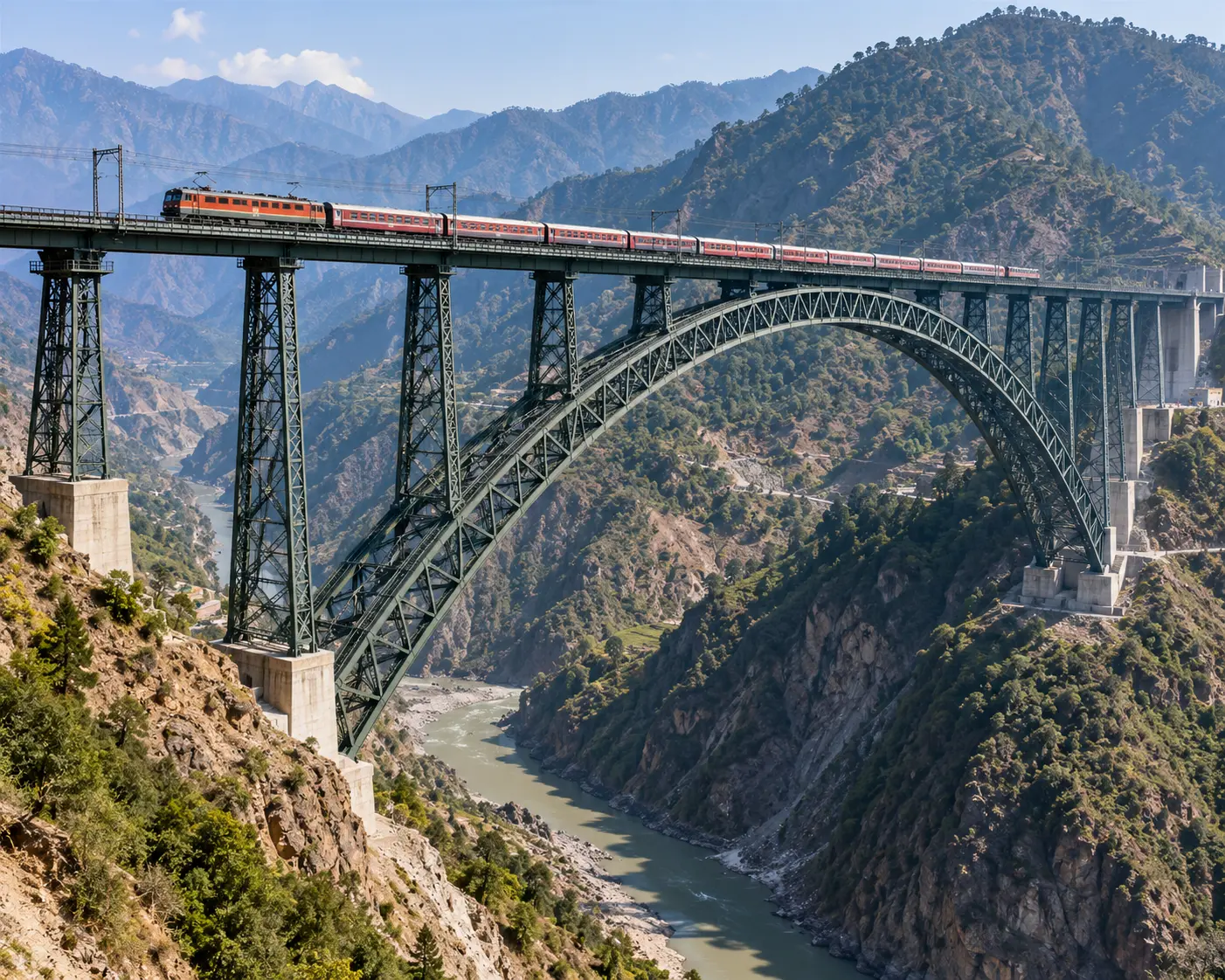
Below lies the Chenab River, cutting through a deep Himalayan gorge. On either side are steep mountain slopes. Connecting them is an enormous steel arch supporting a railway line at a height that once seemed almost impossible.
Welcome to the Chenab Railway Bridge — the world's highest railway arch bridge.
Located in the Reasi district of Jammu and Kashmir, India, the bridge stands 359 metres above the riverbed, approximately 35 metres higher than the Eiffel Tower.
But its remarkable height is only part of the story.
Behind this engineering achievement are years of planning, complex geological challenges, innovative construction methods and the expertise of thousands of railway professionals.
Since its inauguration in June 2025, the bridge has also become part of a historic transformation in railway connectivity between the Kashmir Valley and the rest of India.
From an Ambitious Idea to an Engineering Landmark
For decades, establishing reliable railway connectivity through the Himalayan terrain of Jammu and Kashmir presented enormous challenges.
Steep mountains, deep valleys, difficult geological formations and extreme weather made conventional railway construction exceptionally demanding.
The Chenab Bridge was developed as part of the Udhampur–Srinagar–Baramulla Rail Link (USBRL), a 272-kilometre railway project intended to connect the Kashmir Valley more directly with India's national railway network.
The wider project includes approximately 119 kilometres of tunnels across 36 tunnels and 943 bridges, including the Chenab Bridge and the Anji Khad Bridge, Indian Railways' first cable-stayed railway bridge.
The main Chenab Bridge construction contract was awarded in 2008, followed by years of complex engineering and construction.
A defining milestone came on 5 April 2021, when engineers successfully connected the two halves of the enormous steel arch with a final 5.6-metre segment.
On 6 June 2025, the Chenab Railway Bridge was officially inaugurated, marking a significant achievement for Indian railway engineering.
359 Metres Above the River: The Engineering Numbers
The scale of the Chenab Bridge is extraordinary.
The structure extends 1,315 metres across the valley, with its railway deck positioned 359 metres above the riverbed.
Its main steel arch spans 467 metres, making it one of the most remarkable large-span railway bridge structures in the world.
The bridge comprises 17 spans and is designed to support trains travelling at speeds of up to 100 km/h.
It has a design life of 120 years and is engineered to withstand wind speeds of up to 266 km/h.
Built at an approximate cost of ₹1,486 crore, it demonstrates how modern engineering can overcome some of the most challenging geographical conditions.
But how do you construct a bridge of this scale across a deep Himalayan gorge?
The Engineering Behind the Impossible
Building the Arch from Opposite Mountainsides
Unlike bridges constructed over relatively accessible terrain, the Chenab Bridge could not rely on conventional ground-supported scaffolding.
Instead, engineers assembled the steel arch progressively from opposite sides of the gorge.
Specialised overhead cable cranes transported heavy structural components across the valley, requiring exceptional precision in positioning and alignment.
When the final arch segment was installed in April 2021, the two sides were successfully joined, completing one of the most technically demanding stages of construction.
Almost 29,000 Tonnes of Steel
The bridge involved approximately 28,660 tonnes of steel fabrication, with the enormous arch alone weighing around 10,619 tonnes.
Its construction required specialised welding, structural fabrication, quality inspections and extensive testing.
Advanced engineering software, including Tekla, supported structural modelling and detailing, while ultrasonic testing helped verify the quality of welded connections.
For railway professionals, the project demonstrates the importance of integrating structural engineering, construction technology, digital modelling and quality assurance.
Designed to Withstand Nature's Challenges
Building a bridge 359 metres above a river is impressive. Ensuring its safety and reliability for decades is an even greater challenge.
The Chenab Bridge has been designed to address several demanding environmental conditions.
Extreme Winds: The structure can withstand design wind speeds of up to 266 km/h, although train operations remain subject to separate safety restrictions.
Earthquakes: Located in Seismic Zone V, the bridge incorporates stringent structural design measures to address seismic risks.
Temperature Variations: The structural materials were selected to accommodate the region's demanding temperature conditions.
Long-Term Durability: Its 120-year design life requires rigorous inspection, monitoring and maintenance throughout its operational lifespan.
The project is an excellent example of how railway safety begins long before the first train crosses a bridge.
From Engineering Achievement to Railway Operations
The inauguration of the Chenab Bridge on 6 June 2025 coincided with the introduction of Vande Bharat Express services between Shri Mata Vaishno Devi Katra and Srinagar.
The new railway connection reduced the Katra–Srinagar journey to approximately three hours, providing an important alternative to road travel through mountainous terrain.
The services were subsequently extended to Jammu Tawi in 2026, improving connectivity for passengers travelling across the region.
The operational development also included expanded train capacity to accommodate growing passenger demand.
In October 2026, Vande Bharat services were reported operating at speeds of 100 km/h across the Chenab and Anji bridges.
The transition from construction to passenger service highlights the importance of railway testing, commissioning, safety validation and operational readiness.
How Is the Bridge Transforming Connectivity?
Beyond its engineering record, the Chenab Bridge plays an important role in connecting communities and supporting regional development.
The USBRL corridor improves access to major destinations across Jammu and Kashmir while offering an alternative to long road journeys.
For tourists and pilgrims, it provides additional travel options. For businesses, improved rail connectivity can support regional commerce and access to wider markets.
Products such as Kashmiri apples, dry fruits, pashmina shawls and handicrafts stand to benefit from improved freight connectivity.
The wider railway project has also supported the development of approximately 215 kilometres of access roads, helping improve connectivity for surrounding communities.
The Chenab Bridge is therefore more than an engineering landmark. It is part of an infrastructure investment intended to improve mobility, connectivity and economic opportunity.
The People and Skills Behind the Project
For railway professionals and aspiring engineers, one of the most valuable aspects of the Chenab Bridge is the expertise required to bring it to life.
The wider USBRL project generated more than five crore person-days of employment during implementation. This represents cumulative employment activity rather than the number of individual jobs created.
The project drew upon expertise from multiple engineering disciplines.
Civil and Structural Engineering: Bridge design, structural analysis, large-span construction and steel fabrication.
Geotechnical Engineering: Foundation design, geological investigations and slope stability.
Railway Infrastructure: Track installation, alignment, infrastructure integration and maintenance.
Quality Assurance: Welding inspections, non-destructive testing and structural verification.
Safety and Risk Management: Seismic engineering, wind-related risks, structural monitoring and operational safety.
Railway Operations and Maintenance: Train operations, infrastructure inspections, asset management and long-term maintenance planning.
The Chenab Bridge demonstrates why modern railway projects require professionals who can work across disciplines, adapt to new technologies and solve complex engineering problems.
What Can Railway Professionals Learn from the Chenab Bridge?
The project offers several lessons that apply to railway infrastructure around the world.
Engineering Begins with Understanding the Environment. Complex geological and environmental conditions must be considered from the earliest stages of design.
Construction Innovation Matters. Specialised cable cranes, advanced fabrication methods and carefully planned erection sequences helped make the project possible.
Safety Must Be Designed into Infrastructure. Wind resistance, seismic considerations and structural durability were fundamental requirements.
Collaboration Is Essential. Engineers, construction specialists, quality inspectors and railway authorities had to work together to overcome technical challenges.
Infrastructure Creates Long-Term Career Opportunities. Beyond construction, major railway assets require decades of inspection, monitoring, maintenance and operational expertise.
These lessons extend well beyond the Chenab Bridge and are relevant to bridges, tunnels, high-speed railways, metros and other major transportation projects.
The Bigger Picture: A Bridge That Represents More Than a Record
At 359 metres above the Chenab River, the bridge has earned its place among the world's most extraordinary railway structures.
But its significance goes beyond being higher than the Eiffel Tower.
It demonstrates how innovative engineering, careful planning and multidisciplinary expertise can overcome difficult geographical barriers.
For passengers, it is a remarkable part of the journey through Jammu and Kashmir.
For engineers, it is a case study in structural innovation, advanced construction and risk management.
For aspiring railway professionals, it represents the opportunities that emerge when technical expertise meets challenging real-world problems.
The Chenab Bridge is not simply about how high a railway can be built. It is about how far engineering can take us.
Rails Around the World — An Initiative by Zenith Railway Academy
Through Rails Around the World, Zenith Railway Academy (ZRA) explores extraordinary railway projects, engineering innovations and infrastructure developments transforming transportation across the globe.
From remarkable bridges and tunnels to high-speed railways, metro systems and emerging technologies, the series highlights the engineering, people and ideas behind the world's most fascinating rail networks.
Explore railway learning and professional development opportunities at: https://railwayacademy.org/