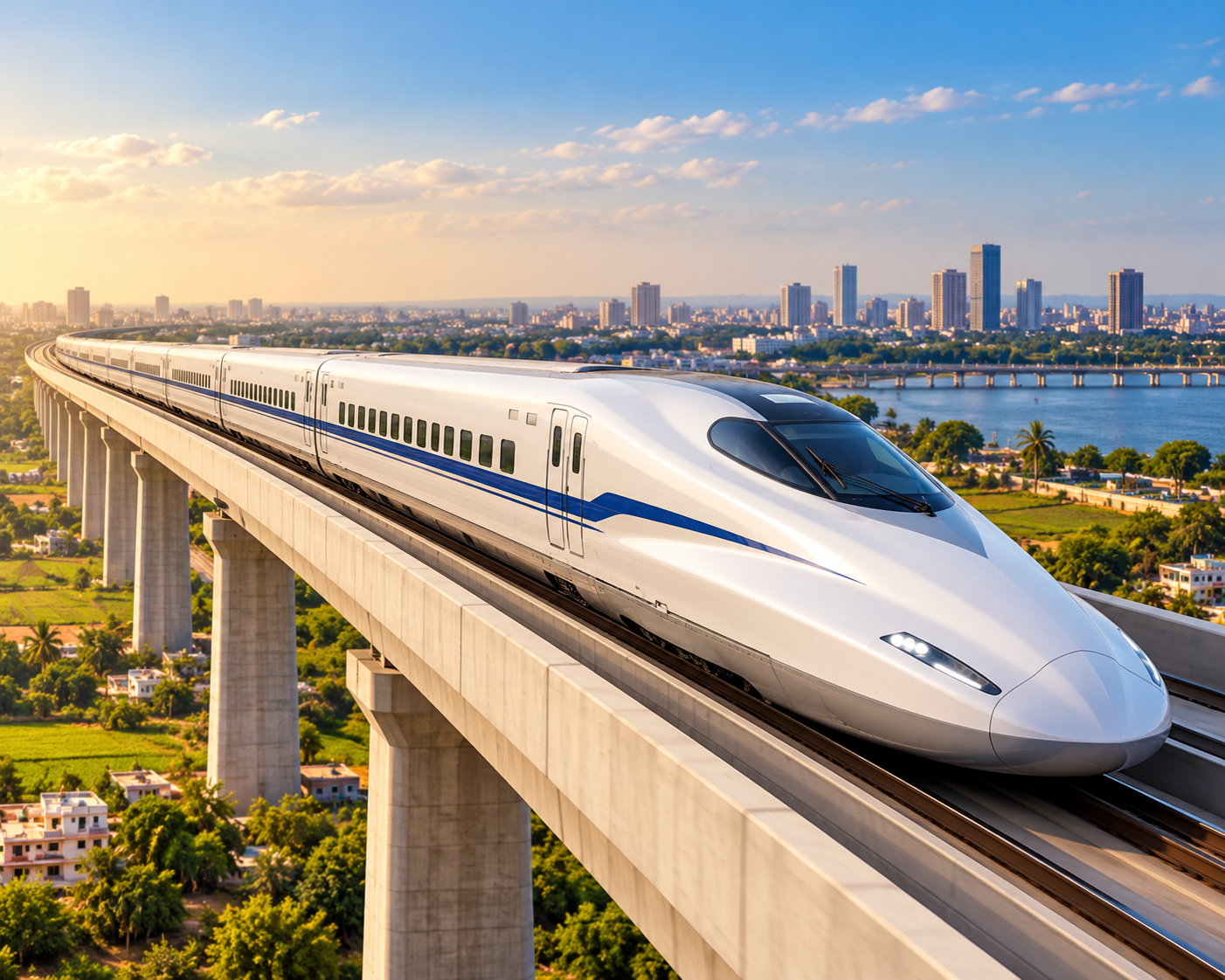
320 km/h trains, a tunnel beneath the sea, Japanese Shinkansen technology, and thousands of employment opportunities. India's first bullet train project is about much more than speed.
Imagine leaving Mumbai and reaching Ahmedabad in approximately two hours.
For millions of Indians accustomed to long intercity journeys, this could represent a significant change in how they travel. For railway professionals, however, the bigger story is what it takes to build and operate an entirely new category of railway.
The Mumbai–Ahmedabad High-Speed Rail (MAHSR) corridor is India's first dedicated bullet train project. Spanning approximately 508 kilometres, it is introducing Japanese Shinkansen technology, specialised railway infrastructure, advanced safety systems and new engineering practices to India.
But how did this ambitious project begin? How far has construction progressed? And what does it mean for the next generation of railway professionals?
From Vision to Reality: How It All Began
India's high-speed rail ambitions began taking shape through feasibility studies and international cooperation with Japan.
A joint feasibility study by Indian Railways and the Japan International Cooperation Agency (JICA) was completed in July 2015.
In February 2016, the National High Speed Rail Corporation Limited (NHSRCL) was established to implement India's first high-speed railway corridor.
The project's foundation stone was laid on 14 September 2017, marking a significant milestone in India–Japan railway cooperation.
Japan agreed to provide technical and financial assistance, including concessional financing for approximately 81% of the original project cost through JICA.
The partnership is not limited to constructing a railway. It includes transferring specialised engineering knowledge, introducing new construction techniques and developing India's own high-speed rail capabilities.
508 Kilometres. 12 Stations. One Major Transformation.
The corridor passes through Maharashtra, Dadra and Nagar Haveli, and Gujarat, connecting several important commercial and industrial centres.
Its 12 planned stations are:
Mumbai (BKC) → Thane → Virar → Boisar → Vapi → Bilimora → Surat → Bharuch → Vadodara → Anand → Ahmedabad → Sabarmati
The railway has been designed for a maximum speed of 350 km/h, with planned commercial operations at up to 320 km/h.
NHSRCL's published operating plan envisages a limited-stop journey of approximately 2 hours and 7 minutes, compared with about 2 hours and 58 minutes for services stopping at every station. A later government backgrounder has cited a faster end-to-end target of about 1 hour and 58 minutes.
Whichever service pattern is eventually introduced, the corridor is intended to make intercity travel considerably faster.
For business travellers, students, professionals and tourists, this could change the practicality of journeys between major western Indian cities.
The Engineering Behind India's First Bullet Train
What makes the Mumbai–Ahmedabad project fascinating is not just the trains themselves, but the engineering infrastructure required to support them.
1. A Railway Built Mostly Above the Ground
Approximately 90% of the corridor is elevated.
Instead of relying predominantly on conventional ground-level railway construction, engineers are building long stretches of concrete viaducts.
One notable construction technique is the Full Span Launching Method, in which large precast bridge girders are transported and positioned using specialised heavy machinery.
Some of these girders are approximately 40 metres long and weigh around 1,000 tonnes.
This approach allows large sections of railway structure to be assembled efficiently, while presenting complex challenges in logistics, precision and quality control.
2. A Railway Tunnel Beneath the Sea
One of the project's most remarkable features is the planned 21-kilometre tunnel section in Maharashtra, which includes approximately 7 kilometres beneath Thane Creek.
This will form part of India's first undersea railway tunnel.
The tunnel is being constructed using a combination of Tunnel Boring Machine (TBM) technology and the New Austrian Tunnelling Method (NATM).
Its construction requires specialised expertise in geotechnical engineering, groundwater management, underground structures, ventilation and railway safety.
3. Advanced Railway Track and Electrification
The corridor is introducing Japanese-style J-Slab ballastless track technology.
Unlike traditional ballasted railway tracks, ballastless systems use engineered concrete track structures designed to maintain precise alignment and support high-speed operation.
The railway will also use advanced 2×25 kV overhead electrification infrastructure, alongside specialised traction power, signalling and train-control systems.
For railway engineers, these are important examples of how high-speed rail requires the integration of multiple technical disciplines.
4. Safety Systems That Prepare for Unexpected Events
Operating at 320 km/h demands much more than a fast train.
The planned infrastructure includes earthquake-detection systems, wind-speed monitoring, rainfall monitoring and advanced train-control arrangements.
For instance, an early earthquake-detection system comprising 28 seismometers is planned to identify seismic activity and initiate protective operational responses.
This is a reminder that high-speed railway engineering is not simply about achieving greater speed. It is about maintaining reliability and safety at those speeds.
How Far Has Construction Progressed?
As of the latest detailed progress information reported in September 2026, the project had achieved 62.16% overall physical progress, according to an NHSRCL response under the Right to Information Act.
The report indicated that:
- All required land, approximately 1,389 hectares, had been acquired.
- Foundation works had been completed along approximately 460 km.
- Pier construction had progressed along approximately 455 km.
- Around 366 km of viaduct girders had been erected.
- Station construction was progressing across Gujarat and Maharashtra.
- Track installation, tunnel works and railway depot construction were continuing.
These figures describe different construction activities, so they should not be interpreted as meaning that 366 km of operational railway is ready.
Government announcements have targeted 2027 for the commencement of the first high-speed rail services, beginning with a section in Gujarat before progressively extending the network.
However, the exact opening sequence has varied across official announcements, and the completion date for the entire Mumbai–Ahmedabad corridor has not yet been firmly confirmed.
For a project of this complexity, construction progress must ultimately be followed by system integration, testing, commissioning and safety validation before passenger operations begin.
How Many Passengers Could Benefit?
The corridor is intended to serve one of India's most economically significant intercity travel markets.
Early project planning documents envisaged approximately 13 million passenger journeys annually, equivalent to roughly 36,000 daily journeys, under the original timetable that assumed operations would begin in 2023.
Because the project timeline has since changed, this is a historical demand forecast rather than a confirmed estimate for its eventual opening year.
The longer-term benefits could extend beyond Mumbai and Ahmedabad themselves.
Cities such as Surat, Vadodara, Vapi and Bharuch are important commercial and industrial centres. Faster connectivity could support business travel, tourism, access to employment and regional economic activity.
There is also an opportunity to improve connections between high-speed rail stations and existing metro, bus and conventional railway networks.
The Sabarmati station area, for example, is being developed as a multimodal transport hub.
Ultimately, the benefits passengers experience will depend on service frequency, fares, station accessibility and the reliability of connecting transport.
More Than a Railway: Thousands of Employment Opportunities
For railway professionals and aspiring engineers, perhaps the most exciting part of the Mumbai–Ahmedabad project is the specialist workforce it is helping to develop.
A June 2026 Government of India backgrounder estimated approximately:
4,000 direct jobs and 35,000–40,000 indirect jobs.
The same report estimated that approximately 40,000 workers would be engaged during construction. This is a separate construction-workforce estimate and should not simply be added to the direct and indirect employment projections.
The opportunities extend across several disciplines:
Civil and Structural Engineering: Viaduct construction, bridge engineering, tunnel construction, geotechnical investigations and specialised infrastructure projects.
Railway Signalling and Train Control: High-speed railway signalling, train-protection systems, safety engineering, testing and commissioning.
Electrical and Traction Engineering: Overhead electrification, traction substations, power distribution and energy-management systems.
Rolling Stock Engineering: Train manufacturing, systems integration, testing, reliability engineering and maintenance.
Railway Operations and Maintenance: Train operations, control centres, infrastructure inspection, asset management and preventive maintenance.
Project Management and Safety Assurance: Construction planning, quality management, risk management, interface coordination and system safety.
These areas represent the types of specialist skills required by high-speed railway projects; they are not a list of currently advertised vacancies.
Building India's Own High-Speed Rail Expertise
One important development is the transfer and localisation of Japanese high-speed railway knowledge.
In February 2026, the Ministry of Railways reported that approximately 1,000 Indian engineers and skilled workers had received training in Japanese railway construction methodology.
A dedicated High-Speed Rail Training Institute at Vadodara and specialised training facilities are contributing to the development of technical capabilities.
Indian organisations are also participating in the production of construction machinery, track-related equipment and other railway components.
This matters because the skills required to build a high-speed railway are not developed overnight.
They require experience with specialised technologies, strict quality requirements, complex multidisciplinary interfaces and internationally established engineering practices.
For young railway professionals, the lesson is clear: emerging railway technologies create opportunities not only for new employment but also for developing expertise that can be transferred to future projects.
What Comes After Mumbai–Ahmedabad?
The Mumbai–Ahmedabad corridor is intended to establish a foundation for wider high-speed rail development in India.
The Union Budget 2026–27 announced seven additional proposed high-speed rail corridors, including routes connecting Mumbai–Pune, Chennai–Bengaluru, Hyderabad–Bengaluru and Delhi–Varanasi.
These are announced proposals, not seven additional railways already under construction.
Their eventual development will depend on feasibility studies, financing, approvals and implementation decisions.
Nevertheless, they indicate why the experience gained from Mumbai–Ahmedabad could be valuable for India's future railway workforce.
The Bigger Picture: Why Railway Professionals Should Pay Attention
The Mumbai–Ahmedabad Bullet Train project is much more than an attempt to reduce journey times.
It is an opportunity to observe how an entire high-speed railway system is planned, financed, engineered, constructed and prepared for operation.
It brings together civil engineering, rolling stock, traction power, signalling, telecommunications, safety assurance, project management and railway operations on a scale that is new to India.
For railway professionals, understanding such projects offers insight into the technologies, technical standards and competencies that may shape the next generation of railway infrastructure.
The most important outcome may not be how quickly a train travels between Mumbai and Ahmedabad, but how much expertise India develops while building the railway that makes the journey possible.
Rails Around the World — An Initiative by Zenith Railway Academy
Through Rails Around the World, Zenith Railway Academy (ZRA) explores extraordinary railway projects, engineering innovations and infrastructure developments that are transforming transportation across the globe.
From high-speed railways and underground metros to pioneering signalling systems and sustainable railway technologies, the series highlights the people, engineering and ideas behind the world's most interesting railway networks.
Explore railway learning and professional development opportunities at: https://railwayacademy.org/