India | Rameswaram, Tamil Nadu
Imagine travelling on a train towards Rameswaram, with the blue waters of the Palk Strait stretching out on either side. Ahead lies a railway bridge that does something rather extraordinary.
It can lift an entire section of railway track into the air to let ships pass underneath.
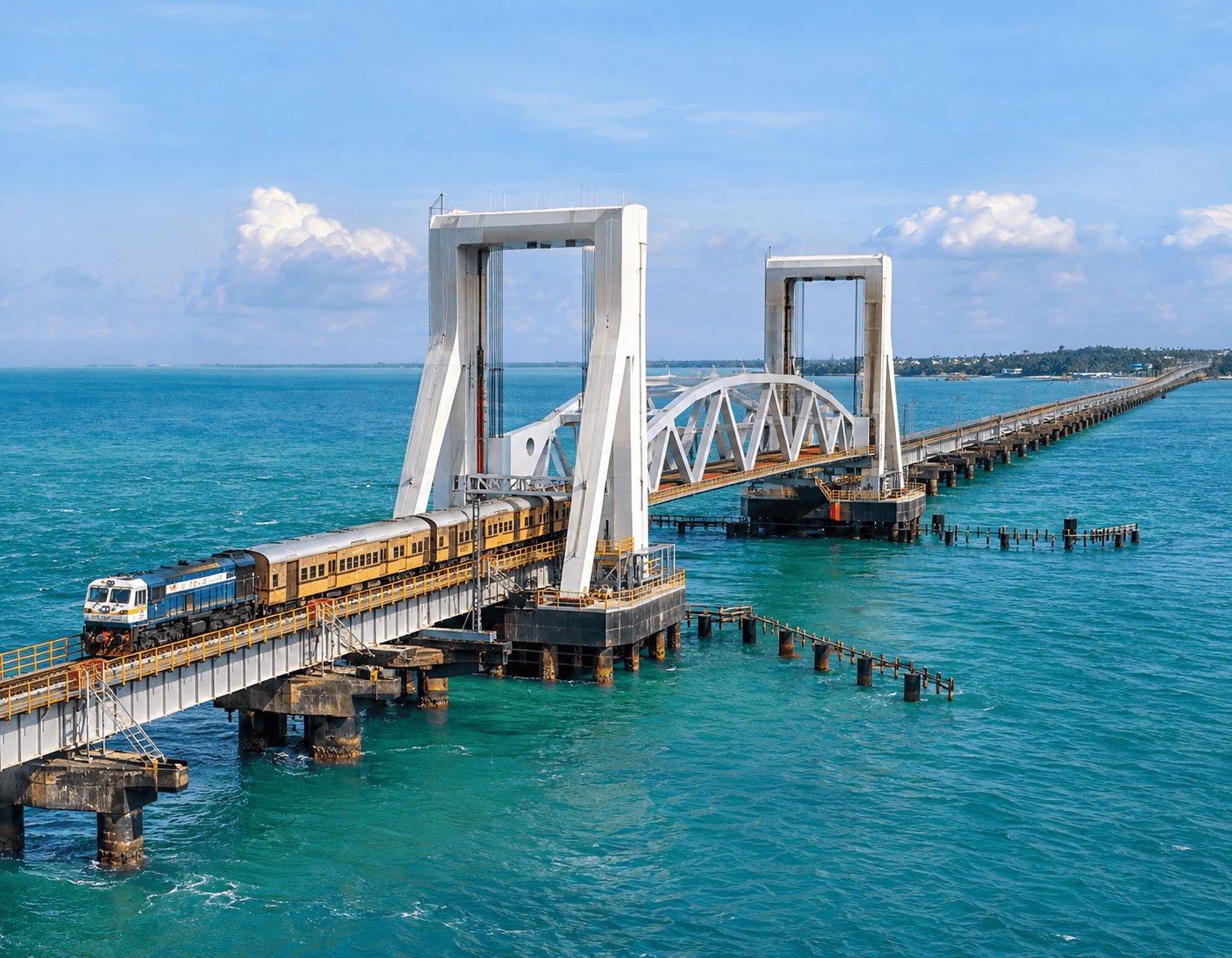
This is the New Pamban Railway Bridge — India's first vertical-lift railway sea bridge, inaugurated on 6 April 2025.
Stretching approximately 2.08 kilometres across the sea, the bridge connects Rameswaram Island with mainland Tamil Nadu. It represents an unusual intersection of railway engineering, maritime navigation and modern infrastructure design.
But to understand why this bridge matters, we need to look back more than a century.
A Century-Old Connection Reimagined
In 1914, the original Pamban Railway Bridge opened, creating a rail connection between Rameswaram and the Indian mainland.
For generations, it carried pilgrims, residents, tourists and goods across the sea.
The original structure was an engineering achievement of its time. Its famous Scherzer rolling-lift span featured two movable sections that opened to allow vessels to navigate through the bridge.
However, maintaining a railway bridge in the middle of the sea is no ordinary task.
Salt-laden air accelerates corrosion. Strong winds place additional demands on structures. Waves, currents and changing weather conditions make inspections, maintenance and repair more difficult.
After more than a century of service, the original bridge was facing significant deterioration. Train operations were suspended in December 2022, highlighting the need for a modern replacement.
The solution was not simply to build a stronger bridge.
It was to rethink how the railway and maritime routes could share the same crossing.
A Bridge That Moves Vertically
The New Pamban Bridge's defining feature is its 72.5-metre-long vertical-lift span.
Unlike the old bridge, which used two sections that opened outward, the new structure lifts its central railway span vertically between two towers.
The mechanism allows the span to rise by approximately 17 metres, creating additional clearance for vessels passing through the navigational channel.
The principle is straightforward:
When a train needs to cross, the movable span remains lowered and secured in its railway operating position.
When a vessel needs to pass, rail movement across the span is stopped, the appropriate safety conditions are established, and the lifting machinery raises the span.
After the vessel clears the channel, the span is lowered, properly seated and secured before railway operations can resume.
This makes Pamban a fascinating example of how railway infrastructure must interact safely with another transport system.
The engineering challenge is not simply lifting a large steel structure. It is ensuring that the structure repeatedly returns to the correct position, with the alignment, stability and operational safeguards needed for trains to cross safely.
The Engineering Behind the Lift
The central span weighs hundreds of tonnes.
Lifting such an enormous structure requires a carefully balanced mechanical system. Counterweights help offset much of the span's weight, reducing the force that the powered lifting machinery must provide.
The arrangement combines structural engineering, mechanical systems, lifting equipment and control arrangements.
For railway engineers, the fascinating question is not only how can such a heavy span be raised?
It is also:
How do you make sure a movable railway bridge is safe for rail traffic every time it closes?
That question brings together structural design, position detection, mechanical locking, signalling, maintenance and operational procedures.
Building in One of the Harshest Environments
Constructing a bridge over the sea presents a different set of challenges from building on land.
The New Pamban Bridge had to contend with strong winds, changing tides, marine corrosion, difficult material transportation and the environmental conditions of the Palk Strait.
The structure includes 99 approach spans of approximately 18.3 metres each, alongside the main 72.5-metre navigational span.
Its foundations incorporate 333 piles and 101 pile caps, supporting the bridge across the marine environment.
Construction was undertaken by Rail Vikas Nigam Limited (RVNL).
Specialised fabrication, welding, lifting and launching arrangements were required to move large steel components into position.
The vertical-lift section itself required extensive assembly and carefully planned launching operations. Working over water meant that many construction activities depended on weather, tidal conditions and the safe movement of heavy materials.
Designing Against Corrosion
Perhaps one of the least visible but most important engineering considerations is corrosion protection.
A sea bridge constantly faces moisture, salt exposure and demanding weather.
The New Pamban Bridge incorporates stainless-steel reinforcement, high-grade protective coatings and welded structural connections intended to improve durability.
Specialised polysiloxane coatings also provide protection against the aggressive marine environment.
These measures matter because the bridge is not merely expected to withstand its initial operating loads.
It must remain serviceable, inspectable and maintainable over decades of exposure.
The real achievement of infrastructure engineering is not only building something impressive. It is ensuring that it continues to perform safely throughout its working life.
Safety Beyond the Structure
A railway sea bridge must be managed as an operational system, not simply as a civil-engineering asset.
At Pamban, wind conditions are a particularly important consideration.
The bridge uses wind-monitoring equipment, including an anemometer, to support safe railway operations. According to the Ministry of Railways, a wind-speed threshold of 58 km/h triggers an automatic red signal to stop train movements.
The movable span also demands coordination between railway operations and marine navigation.
The system must account for whether the bridge is positioned for railway traffic or opened for vessels. Train movements cannot be authorised across the navigational span while it is raised.
For professionals working in railway signalling, safety assurance, operations or maintenance, the bridge offers an interesting case study in the interaction of multiple engineering disciplines.
It illustrates an essential principle:
A railway system is only as dependable as the relationships between its structures, equipment, controls and operating procedures.
Built for Today's Railway, Prepared for Tomorrow
The new bridge was designed with future requirements in mind.
Its substructure provides for two railway tracks, while the approach superstructure initially accommodates a single line.
The new structure also sits approximately three metres higher than the older bridge, improving navigational clearance.
These design decisions demonstrate how railway infrastructure can accommodate present operating requirements while allowing for future capacity and development.
The bridge was inaugurated on 6 April 2025, marking the restoration of an important rail connection to Rameswaram.
Its opening also coincided with the introduction of a new Rameswaram–Tambaram train service, strengthening connections between the island and destinations across Tamil Nadu.
More Than an Engineering Landmark
For Rameswaram, the bridge represents much more than a technological achievement.
The island is a major pilgrimage destination, home to the historic Ramanathaswamy Temple, and an important centre for tourism and local economic activity.
For residents and visitors, reliable rail connectivity is part of everyday mobility.
For the railway industry, the bridge demonstrates what can be accomplished when conventional infrastructure design must adapt to unusual geographical and operational constraints.
And for engineers, it offers an important reminder that the most interesting railway projects are often the ones that demand solutions across multiple disciplines.
Structural engineering alone is not enough.
Mechanical systems, environmental protection, inspection, signalling, safety procedures and long-term maintenance must all work together.
A Railway That Makes Way for the Sea
The original Pamban Bridge connected an island to the mainland for more than a century.
Its successor carries that legacy forward with a very different approach to engineering.
A railway bridge that rises into the air might seem like an unusual sight. Yet behind that movement is a carefully coordinated system designed to reconcile the needs of trains, ships and the demanding marine environment.
The New Pamban Bridge is a reminder that great railway engineering is not always about travelling faster or building bigger. Sometimes, it is about finding a smarter way for different systems to coexist.
And that is what makes it a remarkable story in modern railway infrastructure.
Rails Around the World is a series by Zenith Railway Academy exploring extraordinary railway projects, engineering innovations and infrastructure shaping rail transport across the globe.
Different Tracks. A Brighter Tomorrow.