Next Masterclass—Beyond the Wires - Battery-Electric Trains and the Next Frontier in Railway Traction — 29 Nov 2026 · 7:30 PM–9:30 PM IST (India)—Learn more →— +91 9873 734 543— +91 9599 469 435—[email protected]
Next MasterclassBeyond the Wires - Battery-Electric Trains and the Next Frontier in Railway Traction — 29 Nov 2026 · 7:30 PM–9:30 PM IST (India)Learn more →
Rails Around the World: Japan – Chūō Shinkansen: The 500 km/h Maglev Revolution | Zenith Railway Academy
Article
Rails Around the World: Japan – Chūō Shinkansen: The 500 km/h Maglev Revolution
RA
Railway Academy Editorial
November 24, 202612 min read
Share
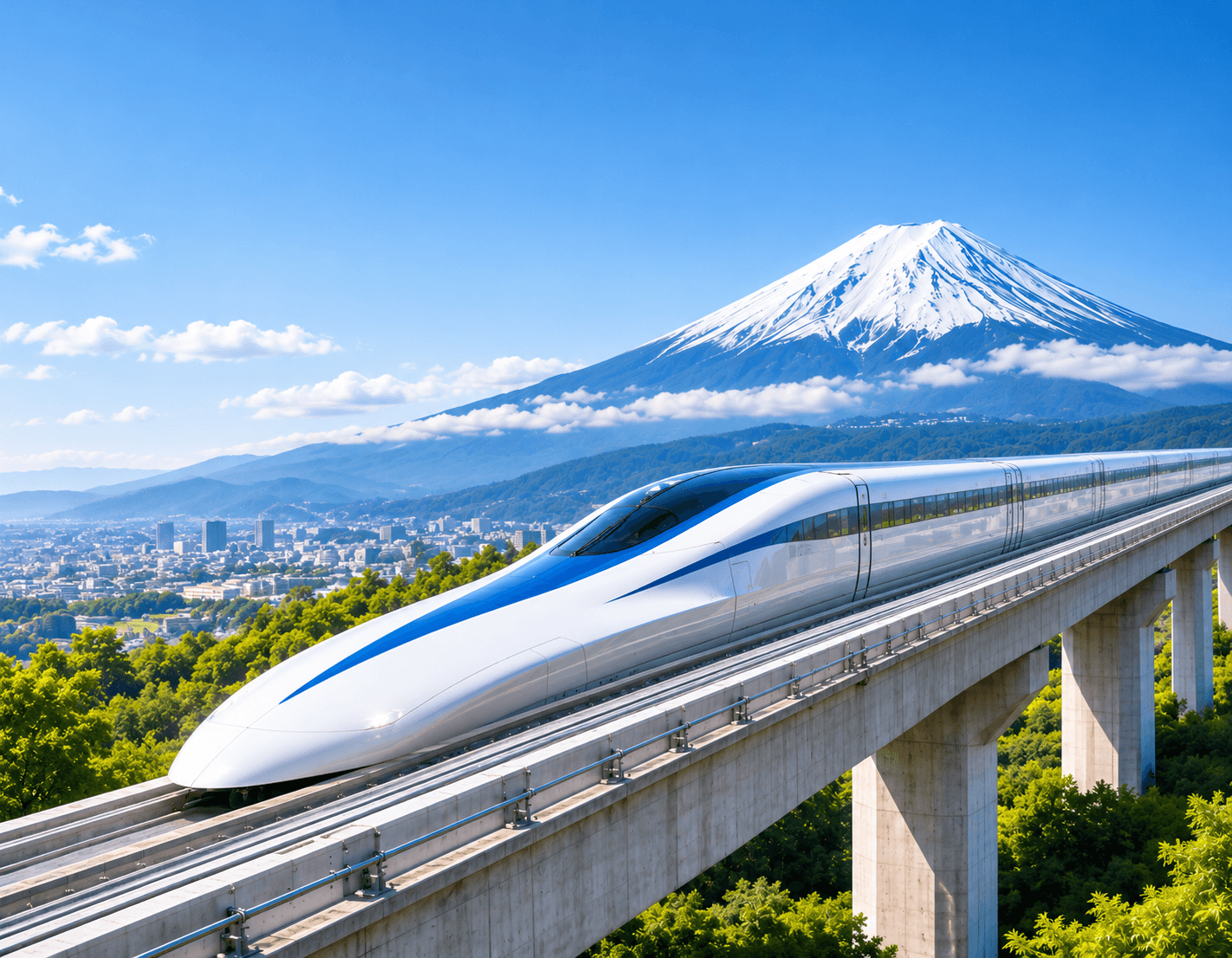
500 km/h operating speeds, trains floating 10 centimetres above their guideways, superconducting magnets and a world record of 603 km/h. Japan's Chūō Shinkansen is about much more than building the fastest railway. It is about reimagining how trains move.
Imagine boarding a train in Tokyo and arriving in Nagoya in approximately 40 minutes.
No aircraft. No conventional railway wheels rolling along steel tracks at cruising speed. Instead, a train travelling at 500 km/h, suspended above its guideway by powerful magnetic forces.
It sounds like something from the future, but Japan has spent decades developing the technology to make it possible.
The Chūō Shinkansen, developed by Central Japan Railway Company (JR Central), is one of the world's most ambitious high-speed railway projects. Using superconducting magnetic levitation technology, it aims to connect Tokyo, Nagoya and eventually Osaka through an entirely new railway corridor.
While Japan's existing Shinkansen network revolutionised high-speed rail travel, the Chūō Shinkansen represents a fundamentally different approach to railway engineering.
But how does a train travel at 500 km/h without conventional wheel-to-rail contact? What makes superconducting maglev technology so remarkable? And why has building this futuristic railway proved so challenging?
From Bullet Trains to Magnetic Levitation: How It All Began
Japan introduced the world to modern high-speed railway travel in 1964 with the opening of the Tōkaidō Shinkansen between Tokyo and Osaka.
The Shinkansen became internationally recognised for its speed, punctuality, safety and operational reliability.
However, Japanese engineers were already exploring technologies that could eventually exceed the capabilities of conventional high-speed rail.
Research into magnetic levitation began decades ago, with the aim of developing a railway system that could travel at extraordinary speeds without depending on conventional wheel-to-rail adhesion.
A major milestone came in April 1997, when running tests began on the Yamanashi Maglev Test Line.
Over the following years, JR Central refined the superconducting magnets, propulsion systems, guideway structures and aerodynamic train designs required for commercial operation.
In 2014, construction of the Chūō Shinkansen between Tokyo and Nagoya officially commenced.
The project represents the culmination of decades of research, testing and engineering development.
Unlike traditional railway modernisation, this initiative involves developing an entirely new transportation system, including its infrastructure, rolling stock, control systems and maintenance requirements.
500 km/h. Three Major Cities. A New Era of Connectivity.
The Chūō Shinkansen is planned to connect three of Japan's most important metropolitan regions:
Tokyo → Nagoya → Osaka
The initial phase will connect Tokyo's Shinagawa Station with Nagoya over approximately 286 kilometres.
Six stations are planned for this first section:
Shinagawa → Kanagawa Prefecture Station → Yamanashi Prefecture Station → Nagano Prefecture Station → Gifu Prefecture Station → Nagoya
The intermediate station names are currently provisional.
The broader Tokyo–Osaka project is planned to extend approximately 438 kilometres.
The proposed journey times demonstrate the scale of the transformation.
Today, the fastest Tōkaidō Shinkansen services connect Tokyo and Nagoya in approximately 86 minutes. The Chūō Shinkansen aims to reduce this journey to just 40 minutes.
Similarly, the journey between Tokyo and Osaka, currently taking approximately 134 minutes on the fastest Shinkansen services, could eventually be completed in approximately 67 minutes.
These comparisons are based on JR Central's project planning figures.
The Chūō Shinkansen is designed for commercial operating speeds of approximately 500 km/h, compared with 285 km/h on the existing Tōkaidō Shinkansen.
These reductions could fundamentally change the relationship between Japan's major cities.
For passengers, faster connections could make business travel, education and intercity mobility more convenient.
For railway engineers, the significance lies in an even bigger question: how can a railway system safely and reliably sustain such extraordinary speeds?
The Engineering Behind Japan's Superconducting Maglev
The most fascinating aspect of the Chūō Shinkansen is not simply how fast the train travels.
It is how the train moves.
Traditional railways use wheels to support the vehicle and transfer traction forces through contact with the rails.
Japan's superconducting maglev system takes a different approach.
It uses powerful magnets mounted on the train and electromagnetic coils installed along a specially designed guideway.
Together, these systems enable propulsion, levitation and guidance without conventional wheel-to-rail contact during high-speed operation.
1. A Train That Floats Above Its Guideway
At high speeds, the superconducting maglev train levitates approximately 10 centimetres above its guideway.
This eliminates the continuous wheel-to-rail contact experienced by conventional trains.
However, magnetic levitation does not mean the train floats at all speeds.
At lower speeds, the train operates on supporting wheels. As speed increases, sufficient magnetic forces are generated to lift the vehicle.
The wheels are then retracted, allowing the train to travel without conventional mechanical contact with the guideway.
This introduces an entirely different set of engineering requirements for vehicle support, stability, maintenance and safe operations.
2. Superconducting Magnets: The Heart of the Technology
The train carries specially designed superconducting magnets.
Superconductivity is a physical phenomenon in which certain materials exhibit essentially zero electrical resistance when cooled below a critical temperature.
This allows the production of extremely powerful magnetic fields.
As the train travels through its guideway, the interaction between the onboard superconducting magnets and the coils installed in the guideway produces the forces needed for levitation and guidance.
Developing this technology requires expertise in cryogenic engineering, materials science, electromagnetic systems and precision manufacturing.
JR Central is also researching high-temperature superconducting technology to simplify equipment and reduce future operating and maintenance costs.
3. Propulsion Without a Conventional Traction Motor
Traditional electric trains generally use rotating traction motors to drive their wheels.
The Chūō Shinkansen uses a linear motor system.
A conventional electric motor produces rotational motion. A linear motor applies similar electromagnetic principles to generate movement along a straight path.
Electrical currents supplied to propulsion coils along the guideway create changing magnetic fields.
These interact with the superconducting magnets onboard the train to produce forward motion.
The result is a propulsion system capable of supporting extremely high speeds without relying on conventional wheel-driven traction.
4. Keeping the Train Stable at 500 km/h
Levitation alone is not enough.
A train travelling at 500 km/h must remain accurately positioned within its guideway, even while experiencing changing aerodynamic forces.
The Chūō Shinkansen uses levitation and guidance coils positioned along both sides of the guideway.
If the train moves away from the centre, electromagnetic forces act to guide it back toward the intended position.
This makes the guideway itself a critical part of the vehicle's stability system.
Vehicle design, guideway geometry, electromagnetic control and operational monitoring must function together as one integrated system.
5. Aerodynamics at Extraordinary Speeds
At 500 km/h, air resistance becomes one of the most significant engineering challenges.
Reducing wheel-to-rail contact does not eliminate aerodynamic drag.
Engineers must carefully consider train nose profiles, pressure changes, tunnel entry effects, airflow around vehicle surfaces and passenger comfort.
The L0 Series maglev test trains feature exceptionally long, streamlined nose designs intended to improve aerodynamic performance.
JR Central has continued refining its test vehicles, including research into surface treatments and vehicle shapes that reduce resistance.
These advances demonstrate why high-speed railway engineering requires expertise extending well beyond propulsion technology.
A World Record: 603 km/h
One of the most extraordinary milestones in the Chūō Shinkansen programme occurred on 21 April 2015.
During testing on the Yamanashi Maglev Line, JR Central's L0 Series train achieved a speed of 603 km/h.
The achievement was recognised by Guinness World Records as the fastest speed attained by a maglev train.
The record was achieved during controlled testing, not commercial passenger operations.
Nevertheless, it demonstrated the remarkable potential of superconducting magnetic levitation.
The Yamanashi Maglev Test Line, approximately 42.8 kilometres long, has played a crucial role in the programme.
It has allowed engineers to test vehicle performance, propulsion, braking, aerodynamics, reliability and operational behaviour under demanding conditions.
By February 2026, cumulative running distance on the test line had reached approximately 5.48 million kilometres.
For railway professionals, this offers an important lesson.
A record-breaking speed test may capture public attention, but years of repeated testing, validation and refinement are what make new railway technology suitable for reliable commercial operation.
Building a Railway Through Japan's Mountains
The Chūō Shinkansen is as much an infrastructure megaproject as it is a breakthrough in rolling-stock technology.
The route passes through mountainous regions of central Japan and requires extensive underground construction.
Rather than following the coastal alignment of the existing Tōkaidō Shinkansen, the new route travels farther inland.
This creates complex challenges involving geology, tunnelling, groundwater, excavation and environmental management.
Major construction activities include:
Deep underground station construction in major cities.
Long mountain tunnels through difficult geological formations.
Urban tunnelling using specialised shield machines.
Construction of guideways, bridges and emergency-access facilities.
Installation of electromagnetic propulsion, levitation and guidance systems.
Development of dedicated maintenance and operational infrastructure.
The Southern Alps Tunnel is particularly significant because of the difficult mountainous terrain it crosses.
Construction requires careful investigation of rock conditions, groundwater behaviour and potential environmental impacts.
Unlike conventional railway projects, the precision requirements of the maglev guideway must also accommodate the electromagnetic systems that support and guide the train.
The challenge is therefore not simply to construct a tunnel or bridge.
It is to deliver infrastructure capable of safely supporting a completely new form of ultra-high-speed transport.
How Far Has Construction Progressed?
Construction of the Chūō Shinkansen has progressed across several locations between Shinagawa and Nagoya.
According to JR Central's project information as of March 2026:
Construction contracts covered approximately 90% of the initial 286-kilometre section.
Land acquisition had reached approximately 85%.
Construction work had commenced at all planned stations between Shinagawa and Nagoya.
Major tunnelling and civil engineering activities were progressing in multiple sections.
These figures describe project development and contracted work, not the percentage of railway ready for passenger operations.
Despite progress, the project has encountered significant delays.
One of its largest challenges has involved the approximately 8.9-kilometre section passing through Shizuoka Prefecture.
Concerns about possible impacts on the Oi River's water resources and the surrounding Southern Alps environment led to prolonged discussions between JR Central and local authorities.
In July 2026, Shizuoka Prefecture approved the start of construction, followed by an environmental preservation agreement.
This was an important breakthrough after years of delays.
However, environmental monitoring, construction safety, difficult tunnelling conditions and local coordination remain essential.
The project's financial requirements have also increased.
In October 2025, JR Central revised its estimated construction cost for the Shinagawa–Nagoya section to approximately ¥11 trillion, reflecting higher prices, challenging engineering work and additional technical requirements.
When Will the Chūō Shinkansen Open?
The original target was to begin operations between Tokyo and Nagoya in 2027.
That target is no longer achievable.
On 18 November 2026, JR Central announced that it would not be able to publish a revised opening schedule before the end of 2026, citing construction delays and further cost assessments.
As of November 2026, the Chūō Shinkansen does not have a confirmed commercial opening date.
The 500 km/h service remains a planned capability rather than an operating passenger railway.
This distinction is important when discussing the project's progress.
The engineering achievements are extraordinary, but construction completion must still be followed by comprehensive system installation, integration, testing, commissioning and safety validation.
More Than Speed: Why Japan Is Building Another Major Railway Corridor
Japan's existing Tōkaidō Shinkansen is already one of the world's most successful high-speed railway systems.
So why invest in an entirely new route?
One important reason is resilience.
The Tōkaidō Shinkansen plays a vital role in connecting Japan's major economic centres.
Any prolonged disruption caused by a major natural disaster, infrastructure failure or extensive maintenance activity could have significant consequences.
By developing the Chūō Shinkansen along a different route, JR Central aims to create an additional major transportation corridor.
This could provide greater network resilience and operational flexibility.
The project could also strengthen economic connections between Tokyo, Nagoya and Osaka.
Shorter journey times may support business activities, employment mobility, tourism and wider regional development.
However, the ultimate passenger benefits will depend on factors such as ticket pricing, service frequency, station accessibility and connections to existing transport networks.
What Does This Mean for Railway Professionals?
For engineers and railway professionals, the Chūō Shinkansen represents an opportunity to study technologies and engineering practices that extend beyond conventional railway systems.
The project requires a diverse range of specialist capabilities.
Electrical and Electromagnetic Engineering: Superconducting magnets, linear propulsion motors, guideway coils, power supply systems and electromagnetic performance.
Civil and Geotechnical Engineering: Mountain tunnelling, deep underground construction, geological investigations, structural engineering and groundwater management.
Rolling Stock Engineering: Aerodynamics, lightweight vehicle design, cryogenic systems, onboard equipment and reliability engineering.
Control Systems and Telecommunications: Train operation control, communication networks, system monitoring and integration of advanced technologies.
Railway Safety and RAMS Engineering: Reliability, availability, maintainability, safety assurance, hazard analysis and system validation.
Operations and Maintenance: Specialist inspection techniques, condition monitoring, infrastructure maintenance and high-speed railway operations.
Project Management and Systems Integration: Coordinating the interfaces between civil structures, guideway equipment, electrical systems, rolling stock and operational requirements.
These represent engineering disciplines involved in developing and operating superconducting maglev technology. They should not be interpreted as a list of currently available vacancies.
For students and early-career professionals, the project illustrates how railway engineering continues to evolve.
Future infrastructure programmes may demand professionals who can combine traditional railway knowledge with advanced electrical systems, digital technologies, control engineering and multidisciplinary systems integration.
The Bigger Picture: What Can the World Learn from Japan?
The Chūō Shinkansen demonstrates both the possibilities and the complexities of introducing revolutionary railway technology.
Its 603 km/h test record shows what superconducting maglev can achieve.
Its planned 500 km/h commercial operations demonstrate Japan's ambition to transform intercity travel.
But its construction challenges reveal an equally important reality.
Engineering innovation must be supported by careful planning, environmental responsibility, stakeholder engagement, financial management and long-term operational reliability.
For countries considering ultra-high-speed transportation, the Chūō Shinkansen provides valuable lessons.
Developing a new railway system is not simply a matter of purchasing faster trains.
It requires an entire ecosystem of infrastructure, technology, engineering expertise, maintenance capabilities, safety systems and operational standards.
And perhaps that is the most important lesson from Japan's magnetic levitation revolution.
The future of high-speed rail will not be defined by speed alone, but by how successfully new technologies can be transformed into safe, reliable and practical transportation systems.
Rails Around the World — An Initiative by Zenith Railway Academy
Through Rails Around the World, Zenith Railway Academy (ZRA) explores extraordinary railway projects, engineering innovations and infrastructure developments that are transforming transportation across the globe.
From high-speed railways and underground metros to pioneering signalling systems and sustainable railway technologies, the series highlights the people, engineering and ideas behind the world's most interesting railway networks.